Entity Embedding

ACTL3143 & ACTL5111 Deep Learning for Actuaries

Patrick Laub

Word Embeddings

Lecture Outline

  • Word Embeddings

  • Word Embeddings II

  • Car Crash NLP Part II

  • Entity Embedding

  • Categorical Variables & Entity Embeddings

  • Keras’ Functional API

  • French Motor Dataset with Embeddings

  • Scale By Exposure

Overview

Popular methods for converting text into numbers include:

  • One-hot encoding
  • Bag of words
  • TF-IDF
  • Word vectors (transfer learning)

Assigning Numbers

Word Vectors

  • One-hot representations capture word ‘existence’ only, whereas word vectors capture information about word meaning as well as location.
  • This enables deep learning NLP models to automatically learn linguistic features.
  • Word2Vec & GloVe are popular algorithms for generating word embeddings (i.e. word vectors).

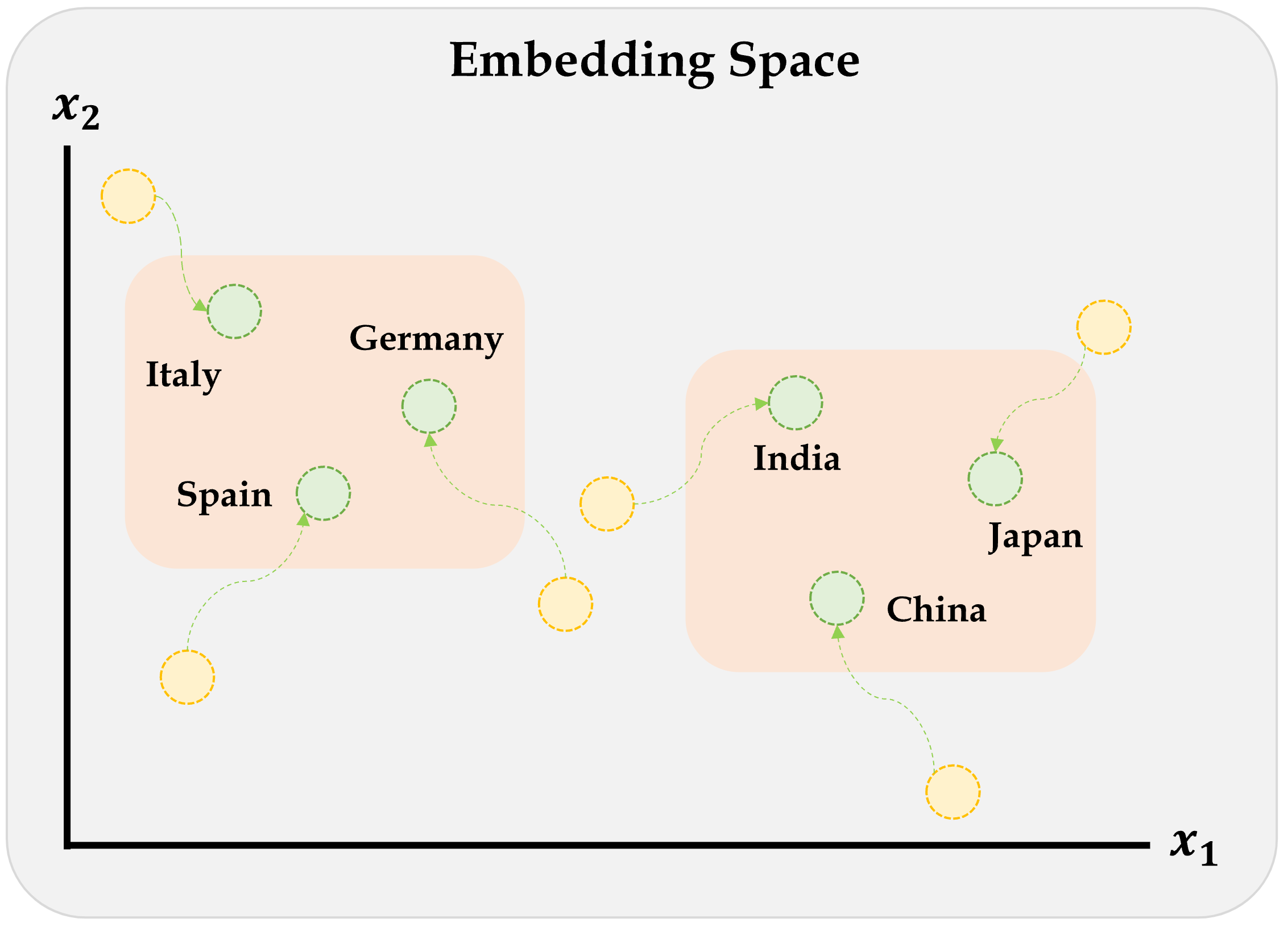
Word Vectors II

Illustrative word vectors.

Remember this diagram?

Embeddings will gradually improve during training.

Word2Vec

Key idea: You’re known by the company you keep.

Two algorithms are used to calculate embeddings:

  • Continuous bag of words: uses the context words to predict the target word
  • Skip-gram: uses the target word to predict the context words

Predictions are made using a neural network with one hidden layer. Through backpropagation, we update a set of “weights” which become the word vectors.

Word2Vec training methods

Continuous bag of words is a centre word prediction task

Skip-gram is a neighbour word prediction task

Suggested viewing

Computerphile (2019), Vectoring Words (Word Embeddings), YouTube (16 mins).

The skip-gram network

The skip-gram model. Both the input vector \boldsymbol{x} and the output \boldsymbol{y} are one-hot encoded word representations. The hidden layer is the word embedding of size N.

Word Vector Arithmetic

Relationships between words becomes vector math.

You remember vectors, right?

Illustrative word vector arithmetic

Screenshot from Word2viz

Word Embeddings II

Lecture Outline

  • Word Embeddings

  • Word Embeddings II

  • Car Crash NLP Part II

  • Entity Embedding

  • Categorical Variables & Entity Embeddings

  • Keras’ Functional API

  • French Motor Dataset with Embeddings

  • Scale By Exposure

Pretrained word embeddings

GloVe (Global Vectors) are pre-trained word embeddings from Stanford, trained on Wikipedia + Gigaword (6 billion tokens, ~400,000 word vocabulary).

GloVe loading code
from pathlib import Path
from urllib.request import urlretrieve
import zipfile, numpy as np

_zip = Path("../data/glove.6B.zip")
if not _zip.exists():
    urlretrieve("https://downloads.cs.stanford.edu/nlp/data/glove.6B.zip", _zip)

words, _rows = [], []
with zipfile.ZipFile(_zip) as _zf:
    with _zf.open("glove.6B.300d.txt") as _f:
        for _line in _f:
            _parts = _line.split()
            words.append(_parts[0].decode("utf-8"))
            _rows.append(_parts[1:])

vectors = np.array(_rows, dtype=np.float32)
vectors /= np.linalg.norm(vectors, axis=1, keepdims=True)
word_to_index = {w: i for i, w in enumerate(words)}

def vec(word):
    return vectors[word_to_index[word]]

def similarity(a, b):
    return float(vec(a) @ vec(b))

def nearest(vector, n=10, exclude=()):
    v = vector / np.linalg.norm(vector)
    sims = vectors @ v
    results = []
    for i in np.argsort(-sims):
        w = words[i]
        if w not in exclude:
            results.append((w, float(sims[i])))
            if len(results) == n:
                break
    return results

def analogy(a, b, c, n=10):
    """a is to b as c is to ?   e.g. analogy("man", "king", "woman") → queen"""
    query = vec(b) - vec(a) + vec(c)
    return nearest(query, n=n, exclude={a, b, c})
f"The size of the vocabulary is {len(words)}"
'The size of the vocabulary is 400000'

Look up a word vector

vec("pizza")
array([ 0.04,  0.07,  0.06, -0.  , -0.03,  0.03, -0.01, -0.04, -0.07,
        0.01, -0.04, -0.1 , -0.03,  0.09, -0.05,  0.  , -0.02, -0.02,
       -0.05,  0.06,  0.05,  0.11, -0.01, -0.02,  0.06, -0.01,  0.04,
        0.  ,  0.06, -0.18, -0.08,  0.07,  0.05, -0.04, -0.08,  0.05,
       -0.06, -0.05, -0.07,  0.04,  0.02,  0.01,  0.  ,  0.08, -0.02,
        0.05,  0.15,  0.02,  0.01, -0.03, -0.01, -0.1 ,  0.05,  0.08,
       -0.03, -0.04, -0.01,  0.05,  0.02, -0.04,  0.12, -0.04, -0.  ,
       -0.07, -0.02, -0.05, -0.03,  0.07, -0.04,  0.04,  0.08,  0.02,
       -0.01, -0.06,  0.02, -0.03, -0.02, -0.01, -0.01, -0.05, -0.02,
        0.06,  0.01, -0.06, -0.02, -0.07,  0.04,  0.04, -0.05,  0.01,
        0.04,  0.02, -0.02, -0.02, -0.  ,  0.01, -0.04,  0.03, -0.06,
        0.01,  0.05, -0.01,  0.  , -0.07, -0.01, -0.06,  0.02,  0.11,
       -0.03,  0.02,  0.05,  0.  ,  0.04, -0.09,  0.06, -0.09, -0.09,
        0.04, -0.05, -0.01, -0.03,  0.02,  0.12, -0.02, -0.04,  0.03,
        0.01,  0.02, -0.05, -0.02,  0.01,  0.06, -0.03, -0.  ,  0.03,
       -0.03,  0.  ,  0.03, -0.02,  0.06,  0.02,  0.01, -0.04, -0.06,
       -0.04,  0.02, -0.01,  0.06, -0.01, -0.07, -0.07,  0.15,  0.05,
       -0.01, -0.07, -0.04, -0.02,  0.04, -0.05, -0.07,  0.07,  0.06,
       -0.06,  0.05, -0.  ,  0.03,  0.01, -0.01,  0.07, -0.03,  0.01,
        0.03, -0.07,  0.05, -0.08,  0.09,  0.01,  0.03,  0.08, -0.11,
       -0.  ,  0.03,  0.05, -0.01,  0.02, -0.02,  0.04,  0.06,  0.05,
       -0.04,  0.09,  0.11, -0.03, -0.02, -0.03,  0.02, -0.12, -0.03,
       -0.06,  0.03,  0.06, -0.1 ,  0.17,  0.04, -0.12, -0.03,  0.11,
       -0.  ,  0.03, -0.  , -0.06,  0.03,  0.06, -0.08, -0.1 ,  0.02,
        0.03, -0.03, -0.03,  0.11,  0.08,  0.06,  0.01, -0.  , -0.11,
       -0.09, -0.01, -0.09, -0.04, -0.04,  0.04,  0.07, -0.02, -0.01,
        0.05, -0.01,  0.17,  0.01, -0.13,  0.03, -0.05, -0.02, -0.01,
       -0.12, -0.07, -0.03, -0.01,  0.06, -0.03, -0.06,  0.17,  0.08,
       -0.01,  0.1 ,  0.02,  0.05, -0.02,  0.04, -0.04,  0.03,  0.05,
       -0.06, -0.02,  0.02,  0.01, -0.06,  0.04,  0.06,  0.07, -0.02,
       -0.09, -0.07,  0.01,  0.06,  0.13, -0.01, -0.17,  0.01, -0.18,
       -0.02, -0.02,  0.05, -0.04,  0.03, -0.01,  0.02,  0.08, -0.04,
        0.05,  0.01,  0.03, -0.  , -0.03,  0.04, -0.07, -0.05,  0.05,
        0.  , -0.06,  0.01], dtype=float32)
len(vec("pizza"))
300

Find nearby word vectors

nearest(vec("python"))
[('python', 1.0),
 ('monty', 0.6837381720542908),
 ('perl', 0.519283652305603),
 ('cleese', 0.5092198848724365),
 ('pythons', 0.5007115006446838),
 ('php', 0.49423137307167053),
 ('grail', 0.4683017432689667),
 ('scripting', 0.467612624168396),
 ('skit', 0.4474538564682007),
 ('javascript', 0.4312553107738495)]
similarity("python", "java")
0.35804617404937744
similarity("python", "sport")
0.005185101181268692
similarity("python", "r")
0.06078970432281494

What does ‘similarity’ mean?

The ‘similarity’ scores

similarity("sydney", "melbourne")
0.7951619625091553

are normally based on cosine distance.

x = vec("sydney")
y = vec("melbourne")
x.dot(y) / (np.linalg.norm(x) * np.linalg.norm(y))
np.float32(0.795162)
similarity("sydney", "aarhus")
0.14399726688861847

Weng’s GoT Word2Vec

In the Game of Thrones (GoT) word embedding space, the top similar words to “king” and “queen” are:

model.most_similar("king")
('kings', 0.897245) 
('baratheon', 0.809675) 
('son', 0.763614)
('robert', 0.708522)
('lords', 0.698684)
('joffrey', 0.696455)
('prince', 0.695699)
('brother', 0.685239)
('aerys', 0.684527)
('stannis', 0.682932)
model.most_similar("queen")
('cersei', 0.942618)
('joffrey', 0.933756)
('margaery', 0.931099)
('sister', 0.928902)
('prince', 0.927364)
('uncle', 0.922507)
('varys', 0.918421)
('ned', 0.917492)
('melisandre', 0.915403)
('robb', 0.915272)

Combining word vectors

You can summarise a sentence by averaging the individual word vectors.

sv = (vec("melbourne") + vec("has") + vec("better") + vec("coffee")) / 4
len(sv), sv[:5]
(300, array([-0.03,  0.03,  0.01,  0.01, -0.01], dtype=float32))

As it turns out, averaging word embeddings is a surprisingly effective way to create word embeddings. It’s not perfect (as you’ll see), but it does a strong job of capturing what you might perceive to be complex relationships between words.

Recipe recommender

Recipes are the average of the word vectors of the ingredients.

Nearest neighbours used to classify new recipes as potentially delicious.

Analogies with word vectors

Obama is to America as ___ is to Australia.

\text{Obama} - \text{America} + \text{Australia} = ?

analogy("america", "obama", "australia")
[('barack', 0.5462056994438171),
 ('canberra', 0.48004958033561707),
 ('australian', 0.4731597900390625),
 ('rudd', 0.46835529804229736),
 ('bush', 0.431667685508728),
 ('mccain', 0.42993825674057007),
 ('gillard', 0.42073196172714233),
 ('australians', 0.4089258909225464),
 ('sydney', 0.40701723098754883),
 ('zealand', 0.3963095545768738)]

Testing more associations

analogy("paris", "france", "london")
[('britain', 0.7673852443695068),
 ('england', 0.62794429063797),
 ('uk', 0.6197735071182251),
 ('british', 0.6013830900192261),
 ('ireland', 0.5365166664123535),
 ('u.k.', 0.5294837355613708),
 ('scotland', 0.5195812582969666),
 ('australia', 0.5150107145309448),
 ('wales', 0.5144591927528381),
 ('europe', 0.5047693848609924)]

Quickly get to bad associations

analogy("man", "king", "woman")
[('queen', 0.6713277101516724),
 ('princess', 0.5432624816894531),
 ('throne', 0.538610577583313),
 ('monarch', 0.5347574949264526),
 ('daughter', 0.49802514910697937),
 ('mother', 0.49564433097839355),
 ('elizabeth', 0.4832652807235718),
 ('kingdom', 0.47747093439102173),
 ('prince', 0.4668240547180176),
 ('wife', 0.4647327661514282)]
analogy("man", "programmer", "woman")
[('programmers', 0.4976009428501129),
 ('freelance', 0.41725867986679077),
 ('educator', 0.40316858887672424),
 ('businesswoman', 0.3929097056388855),
 ('designer', 0.39289426803588867),
 ('translator', 0.38584306836128235),
 ('technician', 0.3751075267791748),
 ('computer', 0.3749142289161682),
 ('animator', 0.3677002191543579),
 ('homemaker', 0.3675471544265747)]

Bias in NLP models

… there are serious questions to answer, like how are we going to teach AI using public data without incorporating the worst traits of humanity? If we create bots that mirror their users, do we care if their users are human trash? There are plenty of examples of technology embodying — either accidentally or on purpose — the prejudices of society, and Tay’s adventures on Twitter show that even big corporations like Microsoft forget to take any preventative measures against these problems.

The analogy function cheats a little bit

nearest(vec("programmer") - vec("man") + vec("woman"))
[('programmer', 0.7800661325454712),
 ('programmers', 0.4976009428501129),
 ('freelance', 0.41725867986679077),
 ('educator', 0.40316858887672424),
 ('businesswoman', 0.3929097056388855),
 ('designer', 0.39289426803588867),
 ('translator', 0.38584306836128235),
 ('technician', 0.3751075267791748),
 ('computer', 0.3749142289161682),
 ('animator', 0.3677002191543579)]

To get the ‘nice’ analogies, analogy ignores the input words as possible answers.

# ignore (don't return) keys from the input
if w not in exclude:
    results.append((w, float(sims[i])))

Car Crash NLP Part II

Lecture Outline

  • Word Embeddings

  • Word Embeddings II

  • Car Crash NLP Part II

  • Entity Embedding

  • Categorical Variables & Entity Embeddings

  • Keras’ Functional API

  • French Motor Dataset with Embeddings

  • Scale By Exposure

Predict injury severity

features = df["SUMMARY_EN"]
target = LabelEncoder().fit_transform(df["INJSEVB"])

X_main, X_test, y_main, y_test = \
    train_test_split(features, target, test_size=0.2, random_state=1)
X_train, X_val, y_train, y_val = \
    train_test_split(X_main, y_main, test_size=0.25, random_state=1)
X_train.shape, X_val.shape, X_test.shape
((4169,), (1390,), (1390,))

Using TF-IDF Vectorization

from sklearn.feature_extraction.text import TfidfVectorizer

max_tokens = 1_000
vect = TfidfVectorizer(
    max_features=max_tokens,
    lowercase=True,
    token_pattern=r"(?u)\b\w+\b",  # Similar to "lower_and_strip_punctuation"
)

X_train_txt = vect.fit_transform(X_train).toarray()
X_val_txt = vect.transform(X_val).toarray()
X_test_txt = vect.transform(X_test).toarray()

vocab = vect.get_feature_names_out()
print(list(vocab[:50]))
['0', '1', '10', '105', '12', '15', '150', '16', '17', '18', '19', '1990', '1991', '1992', '1993', '1994', '1995', '1996', '1997', '1998', '1999', '2', '20', '2000', '2001', '2002', '2003', '2004', '2005', '2006', '2007', '21', '22', '23', '24', '25', '26', '27', '28', '29', '3', '30', '30mph', '31', '32', '33', '34', '35', '35mph', '36']

The TF-IDF vectors

pd.DataFrame(X_train_txt, columns=vocab, index=X_train.index)
0 1 10 105 12 15 150 16 17 18 ... worked working works would yaw year years yellow yield zone
2532 0.0 0.0 0.0 0.0 0.0 0.0 0.0 0.0 0.0 0.0 ... 0.0 0.0 0.0 0.027580 0.0 0.019694 0.0 0.000000 0.0 0.0
6209 0.0 0.0 0.0 0.0 0.0 0.0 0.0 0.0 0.0 0.0 ... 0.0 0.0 0.0 0.045898 0.0 0.032775 0.0 0.000000 0.0 0.0
... ... ... ... ... ... ... ... ... ... ... ... ... ... ... ... ... ... ... ... ... ...
206 0.0 0.0 0.0 0.0 0.0 0.0 0.0 0.0 0.0 0.0 ... 0.0 0.0 0.0 0.000000 0.0 0.000000 0.0 0.051053 0.0 0.0
6356 0.0 0.0 0.0 0.0 0.0 0.0 0.0 0.0 0.0 0.0 ... 0.0 0.0 0.0 0.000000 0.0 0.035219 0.0 0.000000 0.0 0.0

4169 rows × 1000 columns

Feed TF-IDF into an ANN

random.seed(42)
tfidf_model = keras.models.Sequential([
    layers.Input((X_train_txt.shape[1],)),
    layers.Dense(250, "relu"),
    layers.Dense(1, "sigmoid")
])

tfidf_model.compile("adam", "binary_crossentropy", metrics=["accuracy"])
tfidf_model.summary()
Model: "sequential"
┏━━━━━━━━━━━━━━━━━━━━━━━━━━━━━━━━━┳━━━━━━━━━━━━━━━━━━━━━━━━┳━━━━━━━━━━━━━━━┓
┃ Layer (type)                     Output Shape                  Param # ┃
┡━━━━━━━━━━━━━━━━━━━━━━━━━━━━━━━━━╇━━━━━━━━━━━━━━━━━━━━━━━━╇━━━━━━━━━━━━━━━┩
│ dense (Dense)                   │ (None, 250)            │       250,250 │
├─────────────────────────────────┼────────────────────────┼───────────────┤
│ dense_1 (Dense)                 │ (None, 1)              │           251 │
└─────────────────────────────────┴────────────────────────┴───────────────┘
 Total params: 250,501 (978.52 KB)
 Trainable params: 250,501 (978.52 KB)
 Non-trainable params: 0 (0.00 B)

Fit & evaluate

es = keras.callbacks.EarlyStopping(patience=10, restore_best_weights=True,
    monitor="val_accuracy", verbose=2)

if not Path("models/tfidf-model.keras").exists():
    tfidf_model.fit(X_train_txt, y_train, epochs=1_000, callbacks=[es],
        validation_data=(X_val_txt, y_val), verbose=0)
    tfidf_model.save("models/tfidf-model.keras")
else:
    tfidf_model = keras.models.load_model("models/tfidf-model.keras")
tfidf_model.evaluate(X_train_txt, y_train, verbose=0, batch_size=1_000)
[0.131618469953537, 0.9589829444885254]
tfidf_model.evaluate(X_val_txt, y_val, verbose=0, batch_size=1_000)
[0.26651373505592346, 0.8949640393257141]

Keep text as sequence of tokens

from sklearn.feature_extraction.text import CountVectorizer
import re

max_length = 500
max_tokens = 1_000

# Build vocabulary using CountVectorizer
count_vect = CountVectorizer(max_features=max_tokens-1, lowercase=True,
    token_pattern=r"(?u)\b\w+\b")
count_vect.fit(X_train)
vocab = [""] + list(count_vect.get_feature_names_out())  # Index 0 reserved for padding
word_to_idx = {word: idx for idx, word in enumerate(vocab)}

def texts_to_sequences(texts, word_to_idx, max_length):
    sequences = []
    for text in texts:
        tokens = re.findall(r"(?u)\b\w+\b", text.lower())
        seq = [word_to_idx.get(t, 0) for t in tokens][:max_length]
        seq = seq + [0] * (max_length - len(seq))  # Pad with zeros
        sequences.append(seq)
    return np.array(sequences)

X_train_txt = texts_to_sequences(X_train, word_to_idx, max_length)
X_val_txt = texts_to_sequences(X_val, word_to_idx, max_length)
X_test_txt = texts_to_sequences(X_test, word_to_idx, max_length)

print(vocab[:50])
['', '0', '1', '10', '105', '12', '15', '150', '16', '17', '18', '19', '1990', '1991', '1992', '1993', '1994', '1995', '1996', '1997', '1998', '1999', '2', '20', '2000', '2001', '2002', '2003', '2004', '2005', '2006', '2007', '21', '22', '23', '24', '25', '26', '27', '28', '29', '3', '30', '30mph', '31', '32', '33', '34', '35', '35mph']

A sequence of integers

X_train_txt[0]
array([880, 249, 619, 469, 870, 319,  96, 620,  77, 963, 469, 870, 568,
       620,  77, 392, 958, 849, 493, 870, 493, 224, 620,  77, 605, 818,
        61, 513, 924, 514, 317, 284, 191, 919, 513, 741, 491, 178, 108,
       320, 969,  61, 513, 924, 514, 317, 284, 191, 919, 513, 741, 235,
       178,  77, 691,   0, 900, 788, 870, 161, 605, 818, 741, 957, 313,
       109, 843, 984,  77, 807, 672, 809, 870, 675, 823, 957,  64, 507,
        48, 587, 870, 900, 382, 957, 604, 109, 874, 968, 601,  93, 134,
       219, 133, 870, 885, 620, 870, 249, 943,  77,  17, 179,   0,   0,
       957, 840, 133, 870, 493, 355, 818, 469, 513, 883, 954, 387, 870,
       788, 889, 193, 815, 501, 244, 919, 521, 944,  77,  24, 297,   0,
       957, 606, 469, 513, 924, 118, 870, 759, 493, 976, 501, 486, 889,
       411, 843, 975, 870, 529, 920, 420, 943, 154, 502, 521, 125, 943,
       231, 870, 919, 502, 306, 761,  77, 667, 949, 984,   0, 531,   0,
       118, 870, 493, 397, 870, 320, 943, 840, 469, 870, 568, 620, 870,
       493, 469,   0, 889, 870, 118, 667, 949, 944, 334, 870, 493, 109,
       848, 870, 398, 620, 943, 984, 502, 398, 521, 239, 166, 950, 180,
       889, 377, 728, 469, 870, 493, 109, 968, 166, 896, 314, 889, 262,
       870, 306, 620, 943,  77,   0, 995, 624, 554, 205, 889, 150, 469,
       413, 435,   0, 863, 678, 563, 387, 281, 441, 165, 682, 109,   0,
       431, 957, 626, 446, 958, 889, 661, 935,   0, 133, 870, 885, 620,
       870, 249, 431, 830, 869, 975, 870, 529, 194, 431, 422, 332,   0,
       889, 216, 446, 919, 177, 840, 609,   0, 968, 889, 411, 975, 431,
       761, 870, 667, 182, 116, 431, 868, 761, 944, 333, 870, 493, 109,
       431,   0, 387, 465, 431, 957, 609, 481, 469, 870, 249, 870, 250,
       677, 342, 387, 943, 957, 210, 880, 949, 907, 639, 870, 513, 533,
       521, 781, 620, 905, 513, 870, 250, 712, 957, 210, 125,  77, 306,
       718, 337,   0, 633,   0, 870, 129, 358, 210, 889, 943, 473, 108,
         0, 339,  87, 431, 778, 429,   0, 870, 493, 109, 609, 840, 125,
       966, 125, 870, 118, 667, 949,   0, 870, 900,   0, 870, 306, 620,
       944,  77,  51, 995, 624, 554, 469, 413, 435, 957, 960, 446, 243,
       525, 387,  77, 588, 218, 133, 870, 885, 620, 870, 249, 431, 957,
       626, 446, 958, 449, 397, 989, 975, 870, 249, 619, 431, 830, 431,
       957, 606, 469, 513,  22, 125, 870, 900, 529, 920, 420, 431, 610,
       870, 949, 469, 870, 521, 355, 818, 422,   0, 889, 919, 521, 109,
       206, 870, 493, 431,   0, 125, 870, 949, 828, 502, 919, 109, 839,
       469, 870, 568, 620, 870, 493, 431, 169, 177, 244, 609, 142, 943,
       431, 630, 761, 870, 667, 949, 984, 502, 531, 109,   0, 626,  95,
       431, 334, 870, 493, 431, 856, 571, 482, 109, 957, 412, 889, 150,
       195, 638, 133,  77, 518,   0])

Feed LSTM a sequence of one-hots

from keras.layers import CategoryEncoding, Bidirectional, LSTM
random.seed(42)
one_hot_model = Sequential([Input(shape=(max_length,), dtype="int64"),
    CategoryEncoding(num_tokens=max_tokens, output_mode="one_hot"),
    Bidirectional(LSTM(24)),
    Dense(1, activation="sigmoid")])
one_hot_model.compile(optimizer="adam",
    loss="binary_crossentropy", metrics=["accuracy"])
one_hot_model.summary()
Model: "sequential_1"
┏━━━━━━━━━━━━━━━━━━━━━━━━━━━━━━━━━┳━━━━━━━━━━━━━━━━━━━━━━━━┳━━━━━━━━━━━━━━━┓
┃ Layer (type)                     Output Shape                  Param # ┃
┡━━━━━━━━━━━━━━━━━━━━━━━━━━━━━━━━━╇━━━━━━━━━━━━━━━━━━━━━━━━╇━━━━━━━━━━━━━━━┩
│ category_encoding               │ (None, 500, 1000)      │             0 │
│ (CategoryEncoding)              │                        │               │
├─────────────────────────────────┼────────────────────────┼───────────────┤
│ bidirectional (Bidirectional)   │ (None, 48)             │       196,800 │
├─────────────────────────────────┼────────────────────────┼───────────────┤
│ dense_2 (Dense)                 │ (None, 1)              │            49 │
└─────────────────────────────────┴────────────────────────┴───────────────┘
 Total params: 196,849 (768.94 KB)
 Trainable params: 196,849 (768.94 KB)
 Non-trainable params: 0 (0.00 B)

Fit & evaluate

es = keras.callbacks.EarlyStopping(patience=10, restore_best_weights=True,
    monitor="val_accuracy", verbose=2)

if not Path("models/one-hot-model.keras").exists():
    one_hot_model.fit(X_train_txt, y_train, epochs=1_000, callbacks=[es],
        validation_data=(X_val_txt, y_val), verbose=0);
    one_hot_model.save("models/one-hot-model.keras")
else:
    one_hot_model = keras.models.load_model("models/one-hot-model.keras")
one_hot_model.evaluate(X_train_txt, y_train, verbose=0, batch_size=1_000)
[0.6978467702865601, 0.6217318177223206]
one_hot_model.evaluate(X_val_txt, y_val, verbose=0, batch_size=1_000)
[0.6978550553321838, 0.6158273220062256]

Custom embeddings

from keras.layers import Embedding
embed_lstm = Sequential([Input(shape=(max_length,), dtype="int64"),
    Embedding(input_dim=max_tokens, output_dim=32, mask_zero=True),
    Bidirectional(LSTM(24)),
    Dense(1, activation="sigmoid")])
embed_lstm.compile("adam", "binary_crossentropy", metrics=["accuracy"])
embed_lstm.summary()
Model: "sequential_2"
┏━━━━━━━━━━━━━━━━━━━━━━━━━━━━━━━━━┳━━━━━━━━━━━━━━━━━━━━━━━━┳━━━━━━━━━━━━━━━┓
┃ Layer (type)                     Output Shape                  Param # ┃
┡━━━━━━━━━━━━━━━━━━━━━━━━━━━━━━━━━╇━━━━━━━━━━━━━━━━━━━━━━━━╇━━━━━━━━━━━━━━━┩
│ embedding (Embedding)           │ (None, 500, 32)        │        32,000 │
├─────────────────────────────────┼────────────────────────┼───────────────┤
│ bidirectional_1 (Bidirectional) │ (None, 48)             │        10,944 │
├─────────────────────────────────┼────────────────────────┼───────────────┤
│ dense_3 (Dense)                 │ (None, 1)              │            49 │
└─────────────────────────────────┴────────────────────────┴───────────────┘
 Total params: 42,993 (167.94 KB)
 Trainable params: 42,993 (167.94 KB)
 Non-trainable params: 0 (0.00 B)

Fit & evaluate

es = keras.callbacks.EarlyStopping(patience=10, restore_best_weights=True,
    monitor="val_accuracy", verbose=2)

if not Path("models/embed-lstm.keras").exists():
    embed_lstm.fit(X_train_txt, y_train, epochs=1_000, callbacks=[es],
        validation_data=(X_val_txt, y_val), verbose=0);
    embed_lstm.save("models/embed-lstm.keras")
else:
    embed_lstm = keras.models.load_model("models/embed-lstm.keras")
embed_lstm.evaluate(X_train_txt, y_train, verbose=0, batch_size=1_000)
[0.7265174984931946, 0.5706404447555542]
embed_lstm.evaluate(X_val_txt, y_val, verbose=0, batch_size=1_000)
[0.7588797807693481, 0.5446043014526367]
embed_lstm.evaluate(X_test_txt, y_test, verbose=0, batch_size=1_000)
[0.7490332126617432, 0.5482014417648315]

Entity Embedding

Lecture Outline

  • Word Embeddings

  • Word Embeddings II

  • Car Crash NLP Part II

  • Entity Embedding

  • Categorical Variables & Entity Embeddings

  • Keras’ Functional API

  • French Motor Dataset with Embeddings

  • Scale By Exposure

Revisit the French motor dataset

Code
from pathlib import Path
from sklearn.datasets import fetch_openml

if not Path("../data/freq_data.csv").exists():
    freq = fetch_openml(data_id=41214, as_frame=True).frame
    freq.to_csv("../data/freq_data.csv", index=False)
else:
    freq = pd.read_csv("../data/freq_data.csv")

freq
IDpol ClaimNb Exposure Area VehPower VehAge DrivAge BonusMalus VehBrand VehGas Density Region
0 1.0 1.0 0.10000 D 5.0 0.0 55.0 50.0 B12 Regular 1217.0 R82
1 3.0 1.0 0.77000 D 5.0 0.0 55.0 50.0 B12 Regular 1217.0 R82
... ... ... ... ... ... ... ... ... ... ... ... ...
678011 6114329.0 0.0 0.00274 B 4.0 0.0 60.0 50.0 B12 Regular 95.0 R26
678012 6114330.0 0.0 0.00274 B 7.0 6.0 29.0 54.0 B12 Diesel 65.0 R72

678013 rows × 12 columns

Data dictionary

Variable Description Preprocessing
IDpol Policy number (unique identifier) Dropped
ClaimNb Number of claims on the given policy Target
Exposure* Total exposure in yearly units Normalised
Area Area code (ordinal) Ordinal Encode
VehPower Power of the car (ordinal encoded) Normalised
VehAge Age of the car in years Normalised
DrivAge Age of the (most common) driver in years Normalised
BonusMalus Bonus–malus level between 50 and 230 (with reference level 100) Normalised
VehBrand* Car brand (nominal) One-hot
VehGas Diesel or regular fuel car (binary) One-hot
Density Density of inhabitants per km2 in the city of the living place of the driver Normalised
Region* Regions in France (prior to 2016) One-hot

The model

Have \{ (\mathbf{x}_i, y_i) \}_{i=1, \dots, n} for \mathbf{x}_i \in \mathbb{R}^{47} and y_i \in \mathbb{N}_0.

Assume the distribution Y_i \sim \mathsf{Poisson}(\lambda(\mathbf{x}_i))

We have \mathbb{E} Y_i = \lambda(\mathbf{x}_i). The NN takes \mathbf{x}_i & predicts \mathbb{E} Y_i.

Note

For insurance, this is a bit weird. The exposures are different for each policy.

\lambda(\mathbf{x}_i) is the expected number of claims for the duration of policy i’s contract.

Normally, \text{Exposure}_i \not\in \mathbf{x}_i, and \lambda(\mathbf{x}_i) is the expected rate per year, then Y_i \sim \mathsf{Poisson}(\text{Exposure}_i \times \lambda(\mathbf{x}_i)).

What values do we see in the data?

Code
freq = freq.drop("IDpol", axis=1).head(25_000)

X_train, X_test, y_train, y_test = train_test_split(
  freq.drop("ClaimNb", axis=1), freq["ClaimNb"], random_state=36861)

# Reset each index to start at 0 again.
X_train_raw = X_train.reset_index(drop=True)
X_test_raw = X_test.reset_index(drop=True)
X_train_raw["Area"].value_counts()
X_train_raw["VehBrand"].value_counts()
X_train_raw["VehGas"].value_counts()
X_train_raw["Region"].value_counts()
Area
C    5514
D    4116
     ... 
B    2387
F     444
Name: count, Length: 6, dtype: int64
VehBrand
B1     4998
B2     4906
       ... 
B11     283
B14     140
Name: count, Length: 11, dtype: int64
VehGas
Regular    10658
Diesel      8092
Name: count, dtype: int64
Region
R24    6493
R82    2112
       ... 
R42      48
R43      26
Name: count, Length: 22, dtype: int64

How we preprocessed last time

from sklearn.compose import make_column_transformer

ct = make_column_transformer(
  (OneHotEncoder(sparse_output=False, drop="first"), ["VehGas", "VehBrand", "Region"]),
  (OrdinalEncoder(), ["Area"]),
  remainder=StandardScaler(),
  verbose_feature_names_out=False
)
X_train = ct.fit_transform(X_train_raw)
X_train_raw.head(3)
Exposure Area VehPower VehAge DrivAge BonusMalus VehBrand VehGas Density Region
0 1.00 A 7.0 8.0 50.0 52.0 B2 Diesel 13.0 R24
1 0.79 B 7.0 7.0 28.0 80.0 B12 Diesel 65.0 R21
2 1.00 C 6.0 13.0 30.0 50.0 B1 Regular 133.0 R53
X_train.head(3)
VehGas_Regular VehBrand_B10 VehBrand_B11 VehBrand_B12 VehBrand_B13 VehBrand_B14 VehBrand_B2 VehBrand_B3 VehBrand_B4 VehBrand_B5 ... Region_R91 Region_R93 Region_R94 Area Exposure VehPower VehAge DrivAge BonusMalus Density
0 0.0 0.0 0.0 0.0 0.0 0.0 1.0 0.0 0.0 0.0 ... 0.0 0.0 0.0 0.0 1.129272 0.366510 0.223226 0.374405 -0.524020 -0.394690
1 0.0 0.0 0.0 1.0 0.0 0.0 0.0 0.0 0.0 0.0 ... 0.0 0.0 0.0 1.0 0.566087 0.366510 0.046100 -1.131699 1.122382 -0.381092
2 1.0 0.0 0.0 0.0 0.0 0.0 0.0 0.0 0.0 0.0 ... 0.0 0.0 0.0 2.0 1.129272 -0.167408 1.108854 -0.994781 -0.641620 -0.363309

3 rows × 39 columns

Categorical Variables & Entity Embeddings

Lecture Outline

  • Word Embeddings

  • Word Embeddings II

  • Car Crash NLP Part II

  • Entity Embedding

  • Categorical Variables & Entity Embeddings

  • Keras’ Functional API

  • French Motor Dataset with Embeddings

  • Scale By Exposure

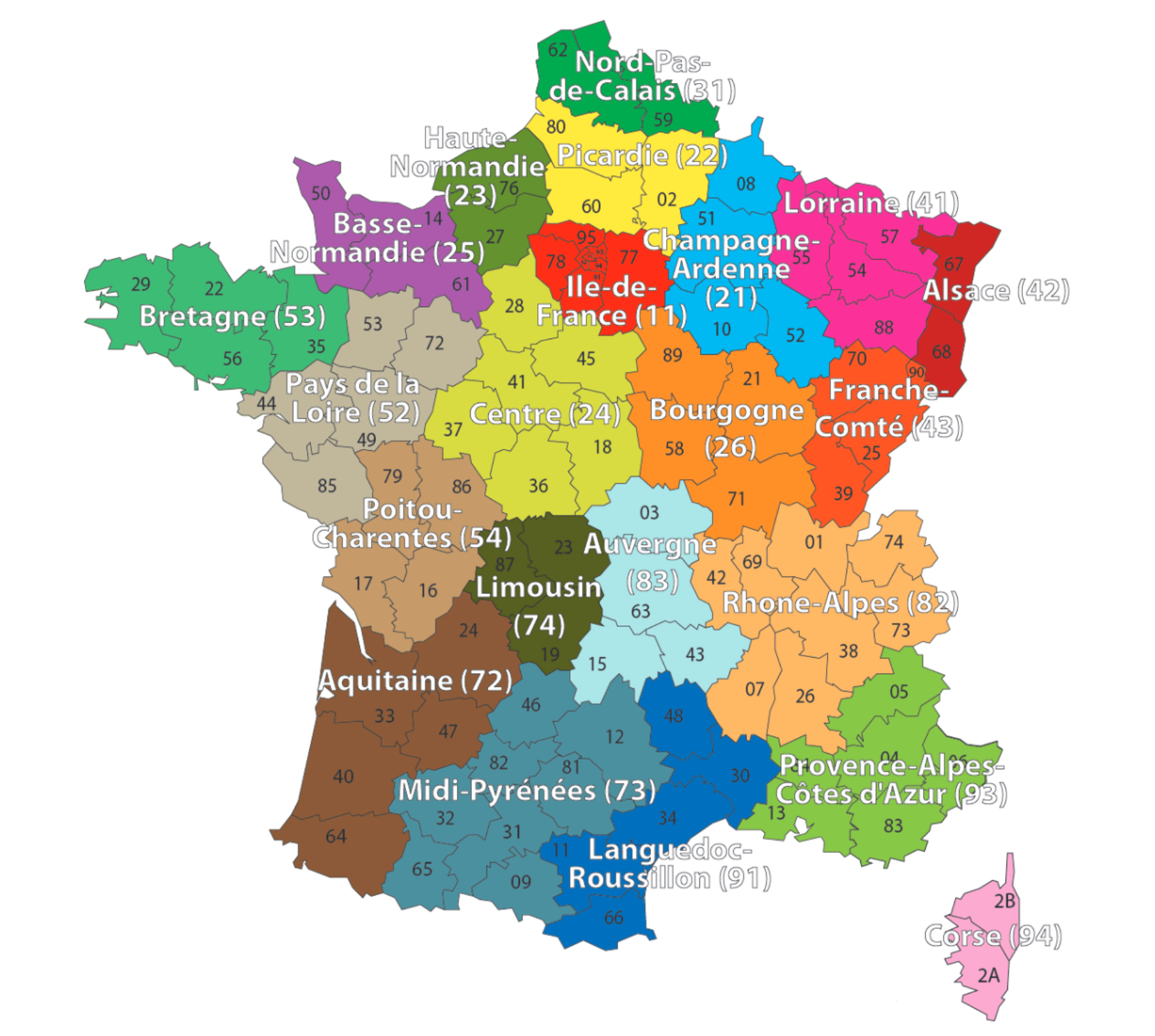
Region column

French Administrative Regions

One-hot encoding

oh = OneHotEncoder(sparse_output=False)
X_train_oh = oh.fit_transform(X_train_raw[["Region"]])
X_test_oh = oh.transform(X_test_raw[["Region"]])
print(list(X_train_raw["Region"][:5]))
X_train_oh.head()
['R24', 'R21', 'R53', 'R24', 'R82']
Region_R11 Region_R21 Region_R22 Region_R23 Region_R24 Region_R25 Region_R26 Region_R31 Region_R41 Region_R42 ... Region_R53 Region_R54 Region_R72 Region_R73 Region_R74 Region_R82 Region_R83 Region_R91 Region_R93 Region_R94
0 0.0 0.0 0.0 0.0 1.0 0.0 0.0 0.0 0.0 0.0 ... 0.0 0.0 0.0 0.0 0.0 0.0 0.0 0.0 0.0 0.0
1 0.0 1.0 0.0 0.0 0.0 0.0 0.0 0.0 0.0 0.0 ... 0.0 0.0 0.0 0.0 0.0 0.0 0.0 0.0 0.0 0.0
... ... ... ... ... ... ... ... ... ... ... ... ... ... ... ... ... ... ... ... ... ...
3 0.0 0.0 0.0 0.0 1.0 0.0 0.0 0.0 0.0 0.0 ... 0.0 0.0 0.0 0.0 0.0 0.0 0.0 0.0 0.0 0.0
4 0.0 0.0 0.0 0.0 0.0 0.0 0.0 0.0 0.0 0.0 ... 0.0 0.0 0.0 0.0 0.0 1.0 0.0 0.0 0.0 0.0

5 rows × 22 columns

Train on one-hot inputs

num_regions = len(oh.categories_[0])

random.seed(12)
model = Sequential([
  Dense(2, input_dim=num_regions),
  Dense(1, activation="exponential")
])

model.compile(optimizer="adam", loss="poisson")

es = EarlyStopping(verbose=True)
hist = model.fit(X_train_oh, y_train, epochs=100, verbose=0,
    validation_split=0.2, callbacks=[es])                       
hist.history["val_loss"][-1]
Epoch 7: early stopping
0.7678699493408203

Make a fake batch of data

X = np.eye(num_regions)
pd.DataFrame(X, columns=oh.categories_[0])
R11 R21 R22 R23 R24 R25 R26 R31 R41 R42 ... R53 R54 R72 R73 R74 R82 R83 R91 R93 R94
0 1.0 0.0 0.0 0.0 0.0 0.0 0.0 0.0 0.0 0.0 ... 0.0 0.0 0.0 0.0 0.0 0.0 0.0 0.0 0.0 0.0
1 0.0 1.0 0.0 0.0 0.0 0.0 0.0 0.0 0.0 0.0 ... 0.0 0.0 0.0 0.0 0.0 0.0 0.0 0.0 0.0 0.0
... ... ... ... ... ... ... ... ... ... ... ... ... ... ... ... ... ... ... ... ... ...
20 0.0 0.0 0.0 0.0 0.0 0.0 0.0 0.0 0.0 0.0 ... 0.0 0.0 0.0 0.0 0.0 0.0 0.0 0.0 1.0 0.0
21 0.0 0.0 0.0 0.0 0.0 0.0 0.0 0.0 0.0 0.0 ... 0.0 0.0 0.0 0.0 0.0 0.0 0.0 0.0 0.0 1.0

22 rows × 22 columns

model.layers[0](X)
tensor([[-0.0600, -0.2381],
        [ 0.0959,  0.0169],
        [-0.3198, -0.2758],
        [ 0.0217, -0.3132],
        [ 0.3903, -0.2820],
        [ 0.0979, -0.4124],
        [ 0.2332, -0.2582],
        [ 0.1300,  0.3135],
        [ 0.6294, -0.4380],
        [ 0.1788, -0.0082],
        [-0.2035, -0.3797],
        [ 0.7685, -0.2326],
        [ 0.5165, -0.0520],
        [ 0.7843, -0.4288],
        [-0.1971, -0.1840],
        [-0.2288, -0.1071],
        [ 0.8012,  0.0942],
        [ 0.5211, -0.1766],
        [-0.0322, -0.6524],
        [ 0.1173,  0.1909],
        [ 0.0334,  0.1478],
        [ 0.3192,  0.5102]], grad_fn=<AddBackward0>)

The first layer

layer = model.layers[0]
W, b = layer.get_weights()
X.shape, W.shape, b.shape
((22, 22), (22, 2), (2,))
X @ W + b
array([[-0.06, -0.24],
       [ 0.1 ,  0.02],
       [-0.32, -0.28],
       [ 0.02, -0.31],
       [ 0.39, -0.28],
       [ 0.1 , -0.41],
       [ 0.23, -0.26],
       [ 0.13,  0.31],
       [ 0.63, -0.44],
       [ 0.18, -0.01],
       [-0.2 , -0.38],
       [ 0.77, -0.23],
       [ 0.52, -0.05],
       [ 0.78, -0.43],
       [-0.2 , -0.18],
       [-0.23, -0.11],
       [ 0.8 ,  0.09],
       [ 0.52, -0.18],
       [-0.03, -0.65],
       [ 0.12,  0.19],
       [ 0.03,  0.15],
       [ 0.32,  0.51]])
W + b
array([[-0.06, -0.24],
       [ 0.1 ,  0.02],
       [-0.32, -0.28],
       [ 0.02, -0.31],
       [ 0.39, -0.28],
       [ 0.1 , -0.41],
       [ 0.23, -0.26],
       [ 0.13,  0.31],
       [ 0.63, -0.44],
       [ 0.18, -0.01],
       [-0.2 , -0.38],
       [ 0.77, -0.23],
       [ 0.52, -0.05],
       [ 0.78, -0.43],
       [-0.2 , -0.18],
       [-0.23, -0.11],
       [ 0.8 ,  0.09],
       [ 0.52, -0.18],
       [-0.03, -0.65],
       [ 0.12,  0.19],
       [ 0.03,  0.15],
       [ 0.32,  0.51]], dtype=float32)

Just a look-up operation

display(list(oh.categories_[0]))
['R11',
 'R21',
 'R22',
 'R23',
 'R24',
 'R25',
 'R26',
 'R31',
 'R41',
 'R42',
 'R43',
 'R52',
 'R53',
 'R54',
 'R72',
 'R73',
 'R74',
 'R82',
 'R83',
 'R91',
 'R93',
 'R94']
W + b
array([[-0.06, -0.24],
       [ 0.1 ,  0.02],
       [-0.32, -0.28],
       [ 0.02, -0.31],
       [ 0.39, -0.28],
       [ 0.1 , -0.41],
       [ 0.23, -0.26],
       [ 0.13,  0.31],
       [ 0.63, -0.44],
       [ 0.18, -0.01],
       [-0.2 , -0.38],
       [ 0.77, -0.23],
       [ 0.52, -0.05],
       [ 0.78, -0.43],
       [-0.2 , -0.18],
       [-0.23, -0.11],
       [ 0.8 ,  0.09],
       [ 0.52, -0.18],
       [-0.03, -0.65],
       [ 0.12,  0.19],
       [ 0.03,  0.15],
       [ 0.32,  0.51]], dtype=float32)

Turn the region into an index

oe = OrdinalEncoder()
X_train_reg = oe.fit_transform(X_train_raw[["Region"]])
X_test_reg = oe.transform(X_test_raw[["Region"]])

for i, reg in enumerate(oe.categories_[0][:3]):
  print(f"The Region value {reg} gets turned into {i}.")
The Region value R11 gets turned into 0.
The Region value R21 gets turned into 1.
The Region value R22 gets turned into 2.

Use an Embedding layer

from keras.layers import Embedding
num_regions = X_train_raw["Region"].nunique()

random.seed(12)
model = Sequential([
  Embedding(input_dim=num_regions, output_dim=2),
  Dense(1, activation="exponential")
])

model.compile(optimizer="adam", loss="poisson")
es = EarlyStopping(verbose=True)
hist = model.fit(X_train_reg, y_train, epochs=100, verbose=0,
    validation_split=0.2, callbacks=[es])
hist.history["val_loss"][-1]
Epoch 5: early stopping
0.7681587934494019
model.layers
[<Embedding name=embedding_1, built=True>, <Dense name=dense_6, built=True>]

Keras’ Embedding Layer

model.layers[0].get_weights()[0]
array([[ 0.06, -0.09],
       [-0.02,  0.03],
       [-0.04, -0.02],
       [ 0.1 , -0.12],
       [ 0.24, -0.22],
       [ 0.17, -0.2 ],
       [ 0.18, -0.18],
       [-0.05,  0.09],
       [ 0.37, -0.34],
       [ 0.03, -0.01],
       [ 0.02, -0.08],
       [ 0.37, -0.31],
       [ 0.21, -0.16],
       [ 0.43, -0.38],
       [-0.03, -0.01],
       [-0.06,  0.02],
       [ 0.26, -0.17],
       [ 0.25, -0.21],
       [ 0.16, -0.22],
       [-0.03,  0.06],
       [-0.03,  0.05],
       [-0.03,  0.11]], dtype=float32)
X_train_raw["Region"].head(4)
0    R24
1    R21
2    R53
3    R24
Name: Region, dtype: str
X_sample = X_train_reg[:4].to_numpy()
X_sample
array([[ 4.],
       [ 1.],
       [12.],
       [ 4.]])
enc_tensor = model.layers[0](X_sample)
keras.ops.convert_to_numpy(enc_tensor).squeeze()
array([[ 0.24, -0.22],
       [-0.02,  0.03],
       [ 0.21, -0.16],
       [ 0.24, -0.22]], dtype=float32)

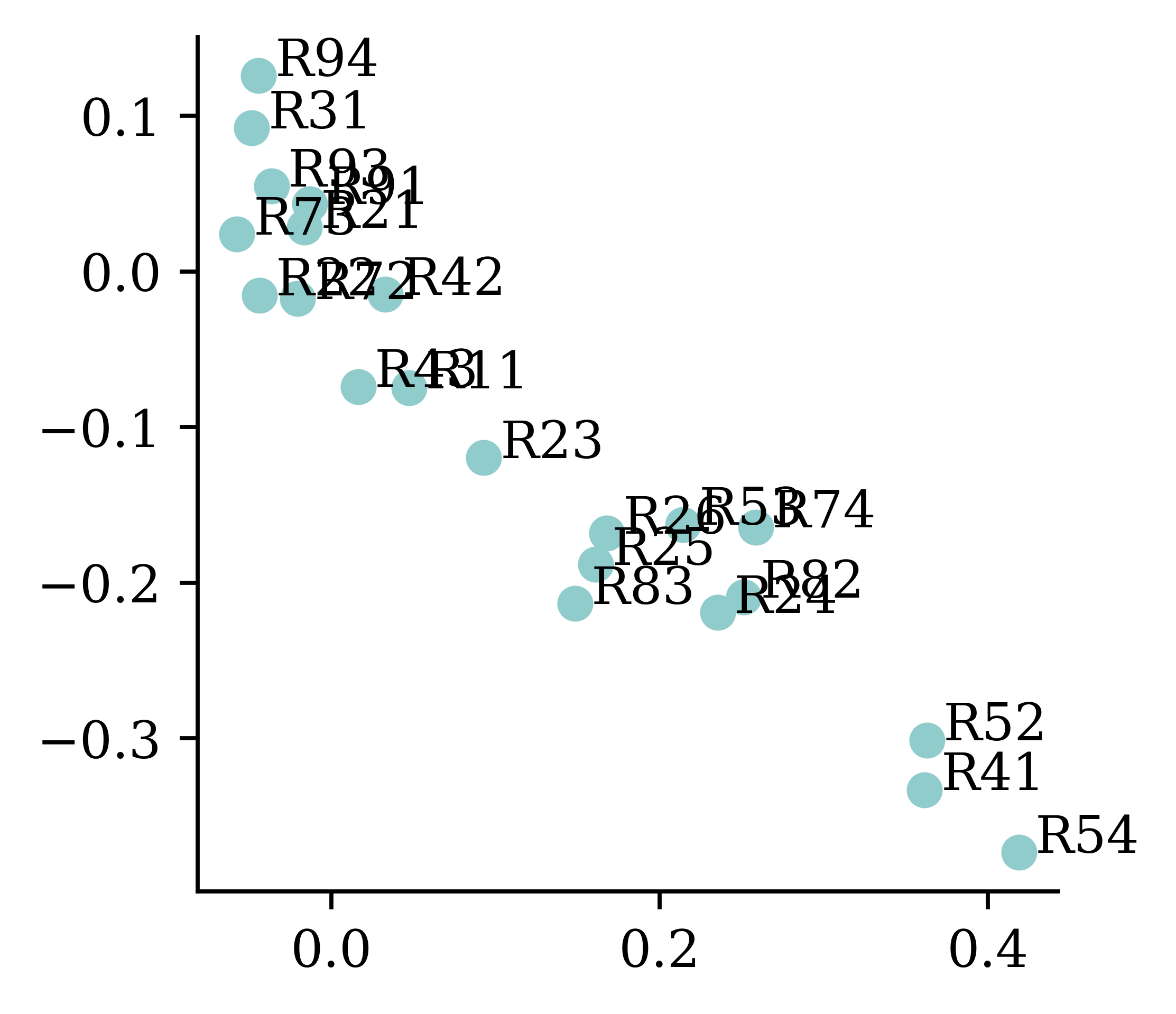
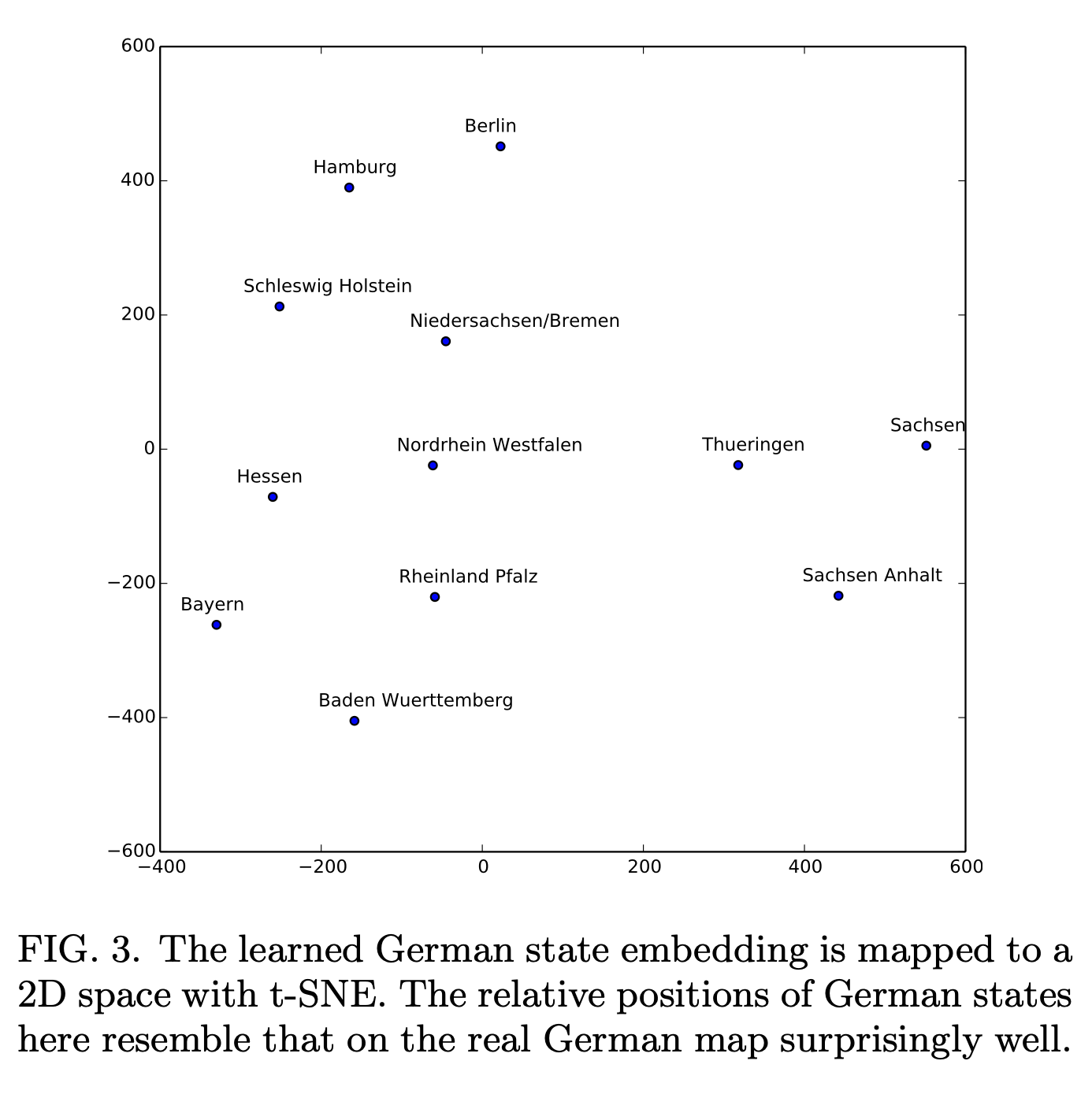
The learned embeddings

points = model.layers[0].get_weights()[0]
plt.scatter(points[:,0], points[:,1])
for i in range(num_regions):
  plt.text(points[i,0]+0.01, points[i,1] , s=oe.categories_[0][i])

Entity embeddings

Embeddings will gradually improve during training.

Embeddings & other inputs

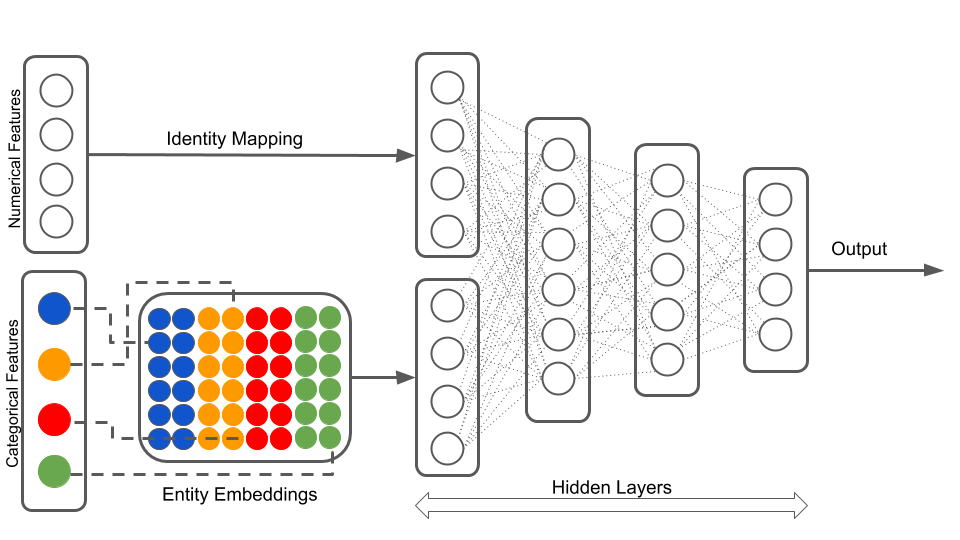
Illustration of a neural network with both continuous and categorical inputs.

We can’t do this with Sequential models…

Keras’ Functional API

Lecture Outline

  • Word Embeddings

  • Word Embeddings II

  • Car Crash NLP Part II

  • Entity Embedding

  • Categorical Variables & Entity Embeddings

  • Keras’ Functional API

  • French Motor Dataset with Embeddings

  • Scale By Exposure

Converting Sequential models

from keras.models import Model
from keras.layers import Input
random.seed(12)

model = Sequential([
  Dense(30, "leaky_relu"),
  Dense(1, "exponential")
])

model.compile(
  optimizer="adam",
  loss="poisson")

hist = model.fit(
  X_train_oh, y_train,
  epochs=1, verbose=0,
  validation_split=0.2)
hist.history["val_loss"][-1]
0.7700952887535095
random.seed(12)

inputs = Input(shape=(X_train_oh.shape[1],))
x = Dense(30, "leaky_relu")(inputs)
out = Dense(1, "exponential")(x)
model = Model(inputs, out)

model.compile(
  optimizer="adam",
  loss="poisson")

hist = model.fit(
  X_train_oh, y_train,
  epochs=1, verbose=0,
  validation_split=0.2)
hist.history["val_loss"][-1]
0.7697821855545044

See one-length tuples.

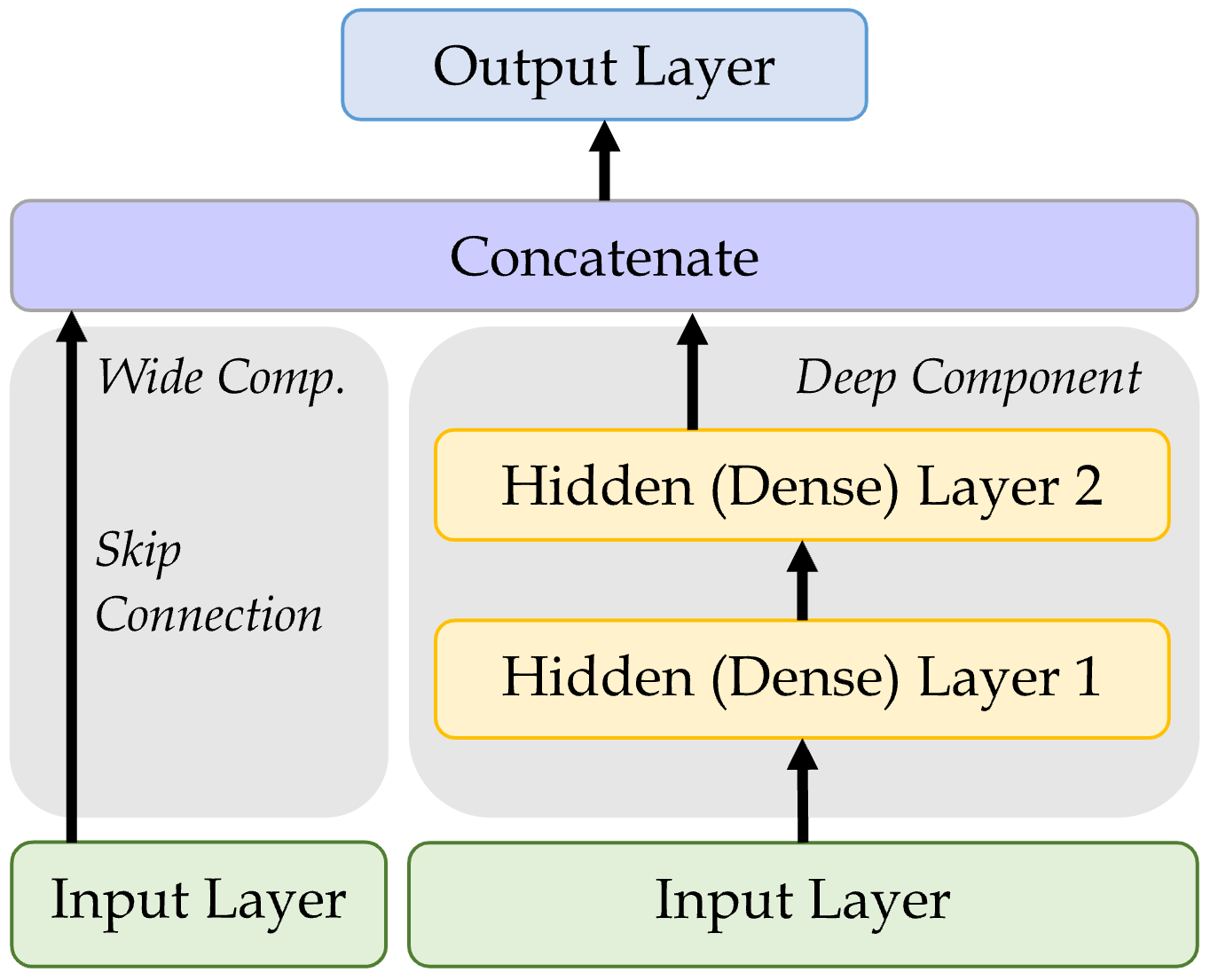
Wide & Deep network

An illustration of the wide & deep network architecture.

Add a skip connection from input to output layers.

from keras.layers \
    import Concatenate

inp = Input(shape=X_train.shape[1:])
hidden1 = Dense(30, "leaky_relu")(inp)
hidden2 = Dense(30, "leaky_relu")(hidden1)
concat = Concatenate()(
  [inp, hidden2])
output = Dense(1)(concat)
model = Model(
    inputs=[inp],
    outputs=[output])

Naming the layers

For complex networks, it is often useful to give meaningful names to the layers.

input_ = Input(shape=X_train.shape[1:], name="input")
hidden1 = Dense(30, activation="leaky_relu", name="hidden1")(input_)
hidden2 = Dense(30, activation="leaky_relu", name="hidden2")(hidden1)
concat = Concatenate(name="combined")([input_, hidden2])
output = Dense(1, name="output")(concat)
model = Model(inputs=[input_], outputs=[output])

Inspecting a complex model
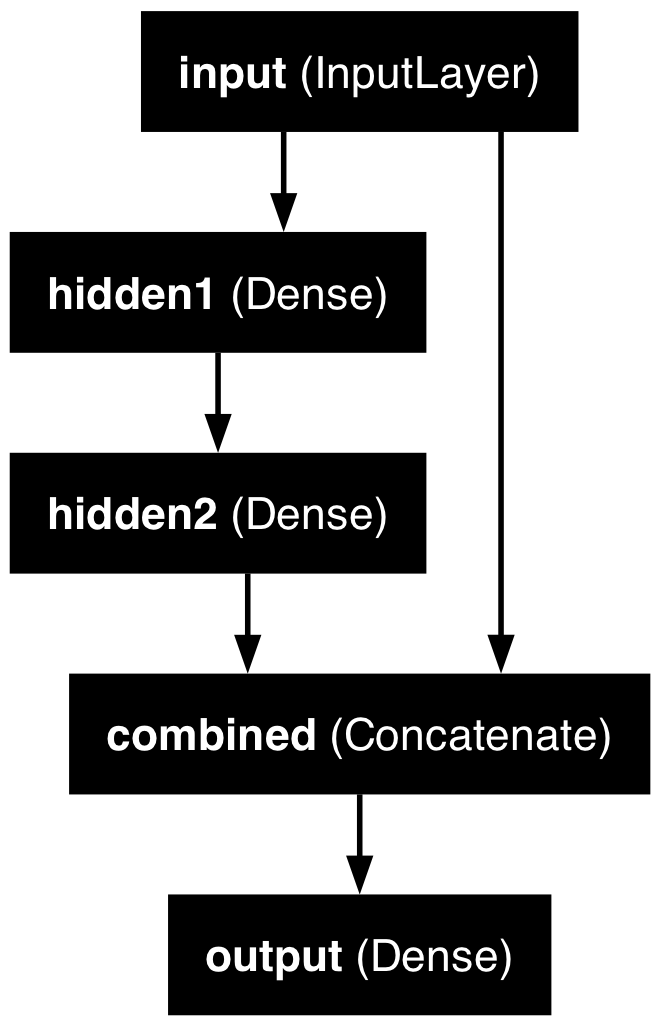
from keras.utils import plot_model
plot_model(model, show_layer_names=True)

model.summary(line_length=75)
Model: "functional_18"
┏━━━━━━━━━━━━━━━━━━━━━┳━━━━━━━━━━━━━━━━━━━┳━━━━━━━━━━━┳━━━━━━━━━━━━━━━━━━━┓
┃ Layer (type)         Output Shape         Param #  Connected to      ┃
┡━━━━━━━━━━━━━━━━━━━━━╇━━━━━━━━━━━━━━━━━━━╇━━━━━━━━━━━╇━━━━━━━━━━━━━━━━━━━┩
│ input (InputLayer)  │ (None, 39)        │         0 │ -                 │
├─────────────────────┼───────────────────┼───────────┼───────────────────┤
│ hidden1 (Dense)     │ (None, 30)        │     1,200 │ input[0][0]       │
├─────────────────────┼───────────────────┼───────────┼───────────────────┤
│ hidden2 (Dense)     │ (None, 30)        │       930 │ hidden1[0][0]     │
├─────────────────────┼───────────────────┼───────────┼───────────────────┤
│ combined            │ (None, 69)        │         0 │ input[0][0],      │
│ (Concatenate)       │                   │           │ hidden2[0][0]     │
├─────────────────────┼───────────────────┼───────────┼───────────────────┤
│ output (Dense)      │ (None, 1)         │        70 │ combined[0][0]    │
└─────────────────────┴───────────────────┴───────────┴───────────────────┘
 Total params: 2,200 (8.59 KB)
 Trainable params: 2,200 (8.59 KB)
 Non-trainable params: 0 (0.00 B)

French Motor Dataset with Embeddings

Lecture Outline

  • Word Embeddings

  • Word Embeddings II

  • Car Crash NLP Part II

  • Entity Embedding

  • Categorical Variables & Entity Embeddings

  • Keras’ Functional API

  • French Motor Dataset with Embeddings

  • Scale By Exposure

The desired architecture

Illustration of a neural network with both continuous and categorical inputs.

Preprocess all French motor inputs

Transform the categorical variables to integers:

num_brands, num_regions = X_train_raw[["VehBrand", "Region"]].nunique()

ct = make_column_transformer(
  (OrdinalEncoder(), ["VehBrand", "Region", "Area", "VehGas"]),
  remainder=StandardScaler(),
  verbose_feature_names_out=False
)
X_train = ct.fit_transform(X_train_raw)
X_test = ct.transform(X_test_raw)

Split the brand and region data apart from the rest:

X_train_brand = X_train["VehBrand"]
X_train_region = X_train["Region"]
X_train_rest = X_train.drop(["VehBrand", "Region"], axis=1)

X_test_brand = X_test["VehBrand"]
X_test_region = X_test["Region"]
X_test_rest = X_test.drop(["VehBrand", "Region"], axis=1)

Organise the inputs

Make a Keras Input for: vehicle brand, region, & others.

veh_brand = Input(shape=(1,), name="veh_brand")
region = Input(shape=(1,), name="region")
other_inputs = Input(shape=X_train_rest.shape[1:], name="other_inputs")

Create embeddings and join them with the other inputs.

from keras.layers import Reshape

random.seed(1337)
veh_brand_ee = Embedding(input_dim=num_brands, output_dim=2,
    name="veh_brand_ee")(veh_brand)                                
veh_brand_ee = Reshape(target_shape=(2,))(veh_brand_ee)

region_ee = Embedding(input_dim=num_regions, output_dim=2,
    name="region_ee")(region)
region_ee = Reshape(target_shape=(2,))(region_ee)

x = Concatenate(name="combined")([veh_brand_ee, region_ee, other_inputs])

Complete the model and fit it

Feed the combined embeddings & continuous inputs to some normal dense layers.

x = Dense(30, "relu", name="hidden")(x)
out = Dense(1, "exponential", name="out")(x)

model = Model([veh_brand, region, other_inputs], out)
model.compile(optimizer="adam", loss="poisson")

hist = model.fit((X_train_brand, X_train_region, X_train_rest),
    y_train, epochs=100, verbose=0,
    callbacks=[EarlyStopping(patience=5)], validation_split=0.2)
np.min(hist.history["val_loss"])
np.float64(0.6853022575378418)

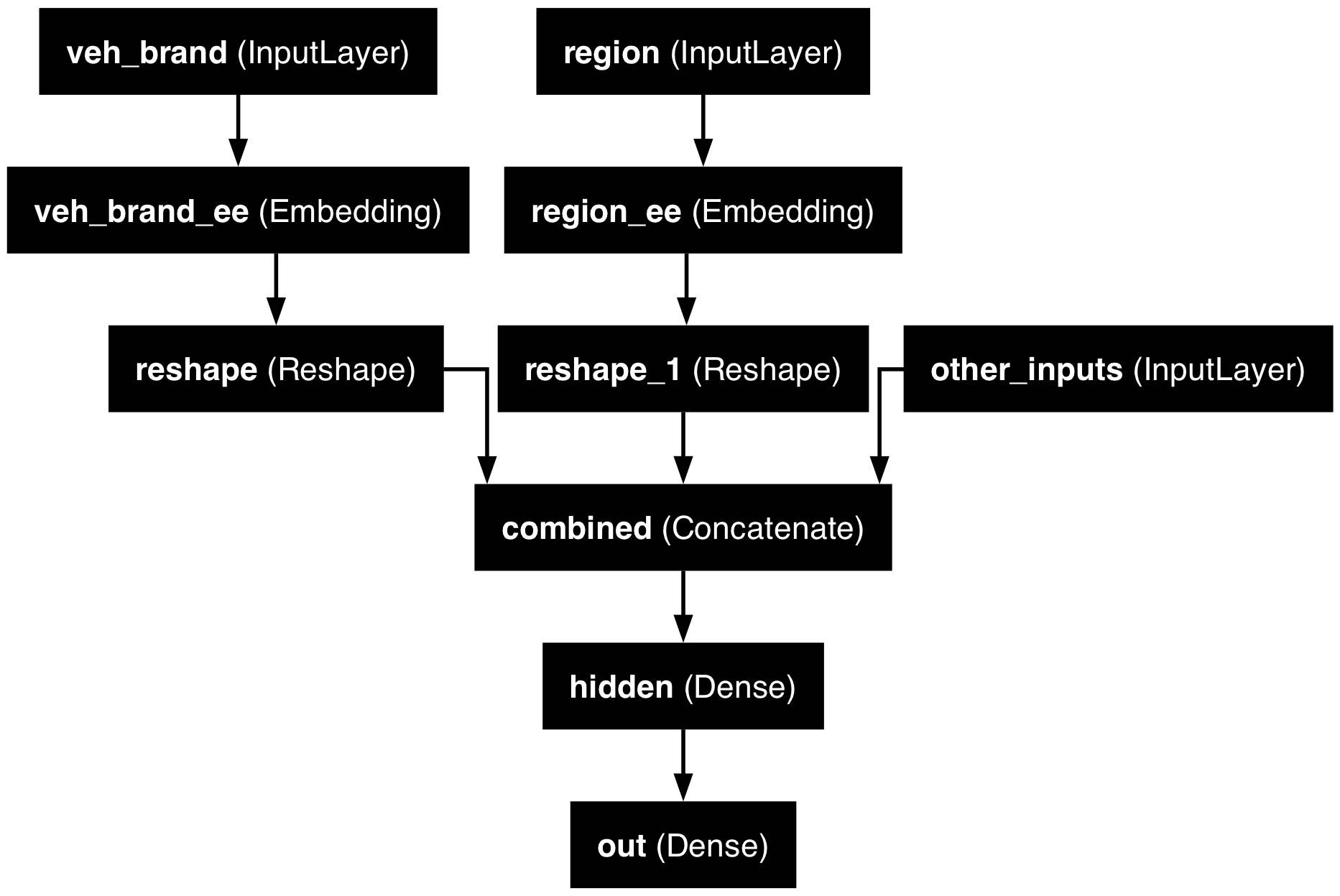
Plotting this model

plot_model(model, show_layer_names=True)

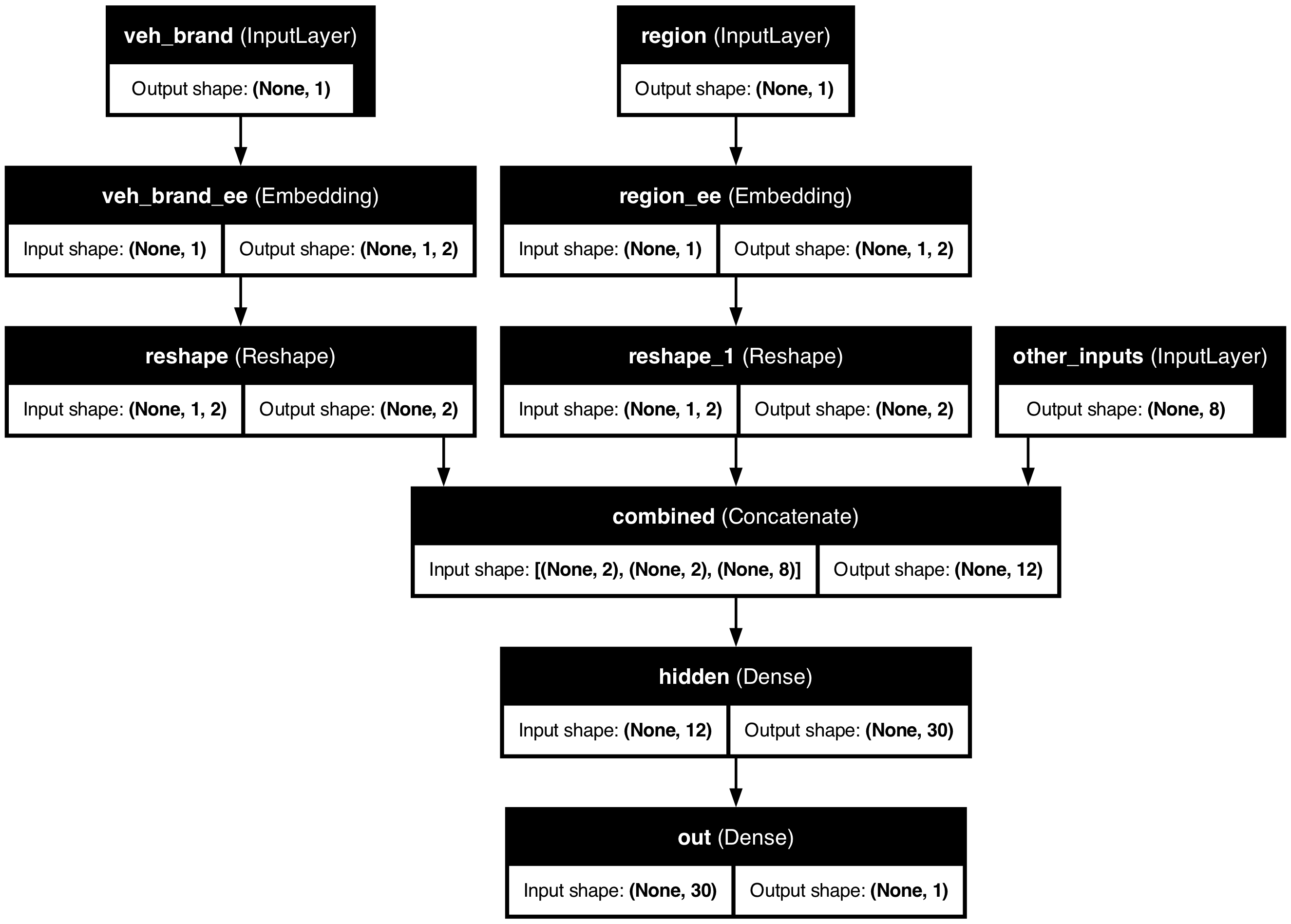
Why we need to reshape

plot_model(model, show_layer_names=True, show_shapes=True)

Scale By Exposure

Lecture Outline

  • Word Embeddings

  • Word Embeddings II

  • Car Crash NLP Part II

  • Entity Embedding

  • Categorical Variables & Entity Embeddings

  • Keras’ Functional API

  • French Motor Dataset with Embeddings

  • Scale By Exposure

Two different models

Have \{ (\mathbf{x}_i, y_i) \}_{i=1, \dots, n} for \mathbf{x}_i \in \mathbb{R}^{47} and y_i \in \mathbb{N}_0.

Model 1: Say Y_i \sim \mathsf{Poisson}(\lambda(\mathbf{x}_i)).

But, the exposures are different for each policy. \lambda(\mathbf{x}_i) is the expected number of claims for the duration of policy i’s contract.

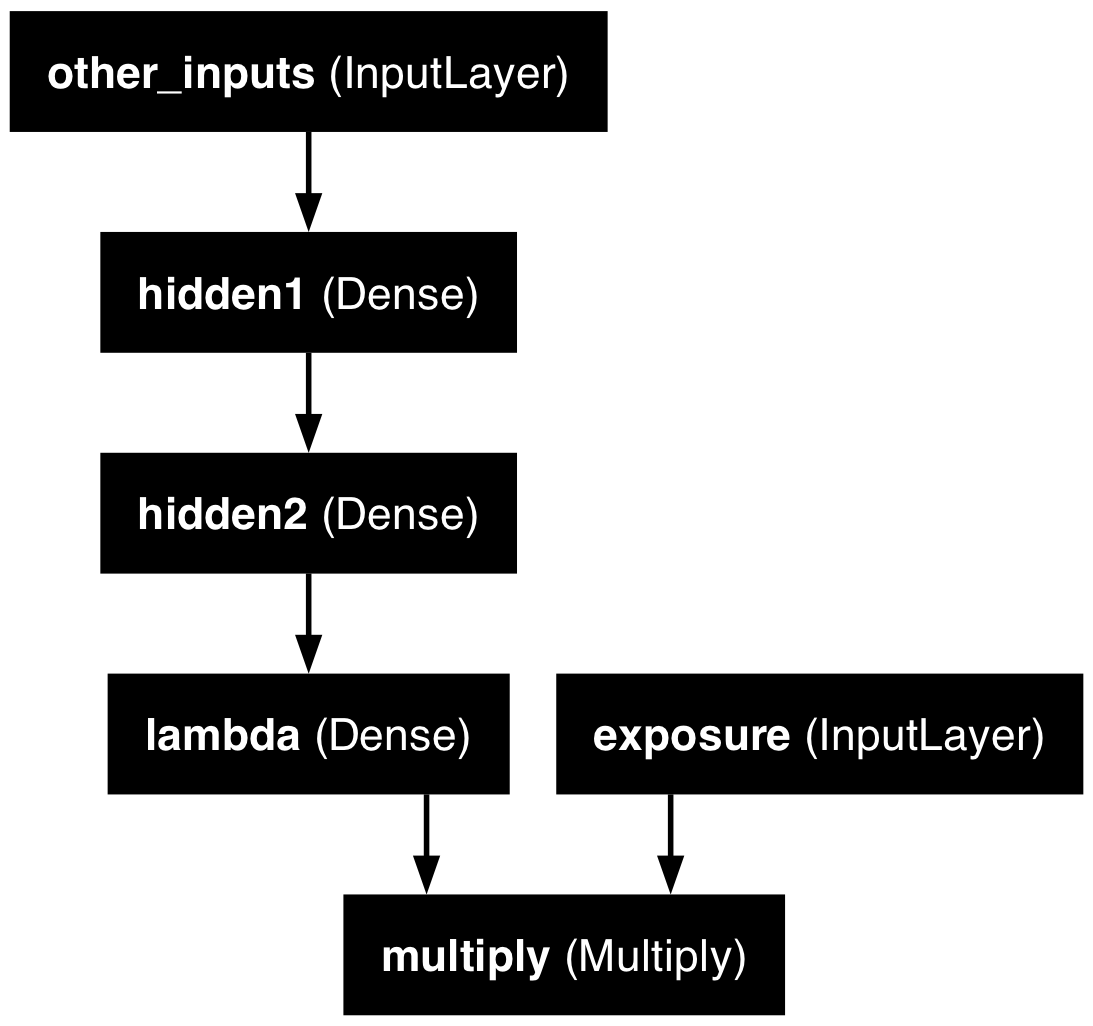
Model 2: Say Y_i \sim \mathsf{Poisson}(\text{Exposure}_i \times \lambda(\mathbf{x}_i)).

Now, \text{Exposure}_i \not\in \mathbf{x}_i, and \lambda(\mathbf{x}_i) is the rate per year.

Just take continuous variables

ct = make_column_transformer(
  ("passthrough", ["Exposure"]),
  ("drop", ["VehBrand", "Region", "Area", "VehGas"]),
  remainder=StandardScaler(),
  verbose_feature_names_out=False
)
X_train = ct.fit_transform(X_train_raw)
X_test = ct.transform(X_test_raw)

Split exposure apart from the rest:

X_train_exp = X_train["Exposure"]
X_test_exp = X_test["Exposure"]
X_train_rest = X_train.drop("Exposure", axis=1)
X_test_rest = X_test.drop("Exposure", axis=1)

Organise the inputs:

exposure = Input(shape=(1,), name="exposure")
other_inputs = Input(shape=X_train_rest.shape[1:], name="other_inputs")

Make & fit the model

Feed the continuous inputs to some normal dense layers.

random.seed(1337)
x = Dense(30, "relu", name="hidden1")(other_inputs)
x = Dense(30, "relu", name="hidden2")(x)
lambda_ = Dense(1, "exponential", name="lambda")(x)
out = lambda_ * exposure # In past, need keras.layers.Multiply()[lambda_, exposure]
model = Model([exposure, other_inputs], out)
model.compile(optimizer="adam", loss="poisson")

es = EarlyStopping(patience=10, restore_best_weights=True, verbose=1)
hist = model.fit((X_train_exp, X_train_rest),
    y_train, epochs=100, verbose=0,
    callbacks=[es], validation_split=0.2)
np.min(hist.history["val_loss"])
Epoch 29: early stopping
Restoring model weights from the end of the best epoch: 19.
np.float64(0.9086945056915283)

Plot the model

plot_model(model, show_layer_names=True)

Package Versions

from watermark import watermark
print(watermark(python=True, packages="keras,matplotlib,numpy,pandas,seaborn,scipy,torch"))
Python implementation: CPython
Python version       : 3.14.3
IPython version      : 9.13.0

keras     : 3.14.1
matplotlib: 3.10.9
numpy     : 2.4.4
pandas    : 3.0.2
seaborn   : 0.13.2
scipy     : 1.17.1
torch     : 2.11.0

Glossary

  • entity embeddings
  • Input layer
  • Keras functional API
  • Reshape layer
  • skip connection
  • wide & deep network