import random
from pathlib import Path

import joblib
import matplotlib.pyplot as plt
import numpy as np
import pandas as pd

from keras.models import Sequential
from keras.layers import Dense, Input
from keras.callbacks import EarlyStopping

import sklearn
from sklearn import set_config
from sklearn.model_selection import train_test_split
from sklearn.preprocessing import OneHotEncoder, OrdinalEncoder, StandardScaler
from sklearn.impute import SimpleImputer
from sklearn.compose import make_column_transformer
from sklearn.pipeline import make_pipeline
from sklearn.linear_model import LinearRegressionPreprocessing
ACTL3143 & ACTL5111 Deep Learning for Actuaries
Patrick Laub
Deep learning project life cycle
- Define objectives
- Collect & label data
- Clean & preprocess data (opt. feature engineering)
- Design network architecture
- Train and validate model
- Hyperparameter tuning
- Test and evaluate performance
- Deploy to production
- Monitor and iterate
(We won’t cover the italicised items in this course, though they are very important.)
Overview
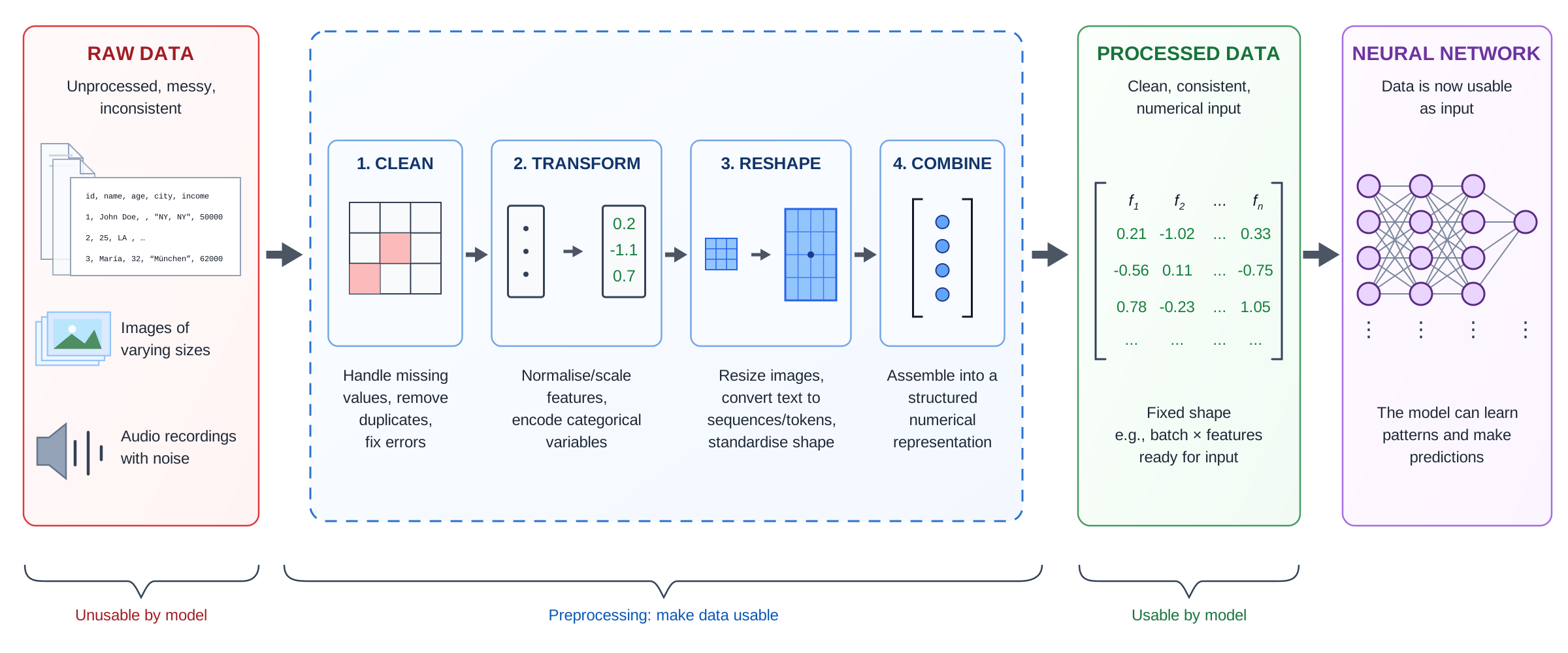
Preprocessing refers to the transformations of the raw data before input to the network. Some steps are specific to neural networks (e.g. standardising continuous variables), others are necessary for every model (e.g. encoding categorical variables, handling missing data).
Imports needed for these demos
Standardising the Numerical Covariates
Lecture Outline
Standardising the Numerical Covariates
Handling Categorical Variables
Missing Values and Rare Observations
Procedures to Keep Your Data Organised
California housing dataset
| MedInc | HouseAge | AveRooms | AveBedrms | Population | AveOccup | Latitude | Longitude | |
|---|---|---|---|---|---|---|---|---|
| 0 | 8.3252 | 41.0 | 6.984127 | 1.023810 | 322.0 | 2.555556 | 37.88 | -122.23 |
| 1 | 8.3014 | 21.0 | 6.238137 | 0.971880 | 2401.0 | 2.109842 | 37.86 | -122.22 |
| ... | ... | ... | ... | ... | ... | ... | ... | ... |
| 20638 | 1.8672 | 18.0 | 5.329513 | 1.171920 | 741.0 | 2.123209 | 39.43 | -121.32 |
| 20639 | 2.3886 | 16.0 | 5.254717 | 1.162264 | 1387.0 | 2.616981 | 39.37 | -121.24 |
20640 rows × 8 columns
Pandas will assign or guess dtypes
Can look at the data types of the features.
<class 'pandas.DataFrame'>
RangeIndex: 20640 entries, 0 to 20639
Data columns (total 8 columns):
 #   Column      Non-Null Count  Dtype
---  ------      --------------  -----
 0   MedInc      20640 non-null  float64
 1   HouseAge    20640 non-null  float64
 2   AveRooms    20640 non-null  float64
 3   AveBedrms   20640 non-null  float64
 4   Population  20640 non-null  float64
 5   AveOccup    20640 non-null  float64
 6   Latitude    20640 non-null  float64
 7   Longitude   20640 non-null  float64
dtypes: float64(8)
memory usage: 1.3 MB
Here, all the features were continuous variables
Pandas can guess wrong though
For example, Australian postcodes are four digits and some start with 0 (e.g. Darwin is 0800). A CSV reader just sees digits, guesses a number, and silently drops the leading zero — giving the column the wrong type and the wrong value.
Default inference:
Splitting into train, validation and test sets
Note that we really cannot allow there to be duplicate rows in the training, validation, or test sets. If there are, we will have data leakage between the sets, which will lead to overfitting and poor generalisation.
Checking for leaks
We can look for rows that appear in multiple of the datasets.
train_val_overlap = pd.merge(X_train_raw, X_val_raw, how='inner')
train_test_overlap = pd.merge(X_train_raw, X_test_raw, how='inner')
val_test_overlap = pd.merge(X_val_raw, X_test_raw, how='inner')

print(f"Number of duplicated rows between train and val: {len(train_val_overlap)}")
print(f"Number of duplicated rows between train and test: {len(train_test_overlap)}")
print(f"Number of duplicated rows between val and test: {len(val_test_overlap)}")
Number of duplicated rows between train and val: 0
Number of duplicated rows between train and test: 0
Number of duplicated rows between val and test: 0An earlier check is to check that there are no duplicate rows in the dataset.
We rescaled every column
array([[ 0.15, -0.76,  0.26, ..., -0.01, -0.47,  0.69],
       [-1.79, -1.48,  0.48, ..., -0.08, -0.44,  1.33],
       [-0.97, -0.13, -0.67, ...,  0.05, -0.86,  0.65],
       ...,
       [ 0.11, -0.84, -0.54, ..., -0.03, -0.81,  0.6 ],
       [-0.82,  0.99, -0.03, ..., -0.03,  0.54, -0.11],
       [ 0.9 , -1.56,  0.66, ...,  0.07, -0.75,  0.97]], shape=(12384, 8))
That is because the neural network expects continuous inputs to be normalised to help with the training procedure.
Note
Notice that the output of X_train here looks a bit different to X_train_raw earlier? We’ll touch on this in a couple of slides.
Scikit-learn preprocessing methods
fit: learn the parameters of the transformationtransform: apply the transformationfit_transform: learn the parameters and apply the transformation
[ 1.14e-16 -1.08e-16 -2.82e-16 -4.45e-17 -6.89e-18 -4.02e-17  1.14e-15
  1.75e-15]
[1. 1. 1. 1. 1. 1. 1. 1.]
[ 0.01  0.01  0.   -0.01 -0.    0.01  0.   -0.01]
[1.01 1. 0.81 0.81 0.98 0.84 0.99 1. ][ 1.14e-16 -1.08e-16 -2.82e-16 -4.45e-17 -6.89e-18 -4.02e-17 1.14e-15
1.75e-15]
[1. 1. 1. 1. 1. 1. 1. 1.]
[ 0.01 0.01 0. -0.01 -0. 0.01 0. -0.01]
[1.01 1. 0.81 0.81 0.98 0.84 0.99 1. ]Dataframes & arrays
| MedInc | HouseAge | AveRooms | AveBedrms | Population | AveOccup | Latitude | Longitude | |
|---|---|---|---|---|---|---|---|---|
| 4712 | 3.2500 | 39.0 | 4.503205 | 1.073718 | 1109.0 | 1.777244 | 34.06 | -118.36 |
| 2151 | 1.9784 | 37.0 | 4.988584 | 1.038813 | 1143.0 | 2.609589 | 36.78 | -119.78 |
| ... | ... | ... | ... | ... | ... | ... | ... | ... |
| 6823 | 4.8750 | 42.0 | 5.347985 | 1.058608 | 829.0 | 3.036630 | 34.09 | -118.10 |
| 11878 | 2.7054 | 52.0 | 5.741214 | 1.060703 | 905.0 | 2.891374 | 33.99 | -117.38 |
4128 rows × 8 columns
array([[-0.33,  0.83, -0.34, ..., -0.11, -0.73,  0.6 ],
       [-1.  ,  0.67, -0.16, ..., -0.04,  0.54, -0.1 ],
       [ 0.07,  1.38, -0.35, ...,  0.06,  0.98, -1.42],
       ...,
       [ 0.62, -0.21, -0.16, ...,  0.05,  0.92, -1.4 ],
       [ 0.53,  1.07, -0.03, ..., -0.  , -0.72,  0.73],
       [-0.62,  1.86,  0.11, ..., -0.02, -0.77,  1.09]], shape=(4128, 8))
Note
By default, when you pass sklearn a DataFrame it returns a numpy array.
Keep as a DataFrame
| MedInc | HouseAge | AveRooms | AveBedrms | Population | AveOccup | Latitude | Longitude | |
|---|---|---|---|---|---|---|---|---|
| 4712 | 3.2500 | 39.0 | 4.503205 | 1.073718 | 1109.0 | 1.777244 | 34.06 | -118.36 |
| 2151 | 1.9784 | 37.0 | 4.988584 | 1.038813 | 1143.0 | 2.609589 | 36.78 | -119.78 |
| ... | ... | ... | ... | ... | ... | ... | ... | ... |
| 6823 | 4.8750 | 42.0 | 5.347985 | 1.058608 | 829.0 | 3.036630 | 34.09 | -118.10 |
| 11878 | 2.7054 | 52.0 | 5.741214 | 1.060703 | 905.0 | 2.891374 | 33.99 | -117.38 |
4128 rows × 8 columns
Replace missing values using a descriptive statistic (e.g. mean, median, or most frequent) along each column, or using a constant value… default=‘mean’
Handling Categorical Variables
Lecture Outline
Standardising the Numerical Covariates
Handling Categorical Variables
Missing Values and Rare Observations
Procedures to Keep Your Data Organised
French motor dataset
<class 'pandas.DataFrame'>
RangeIndex: 678013 entries, 0 to 678012
Data columns (total 12 columns):
 #   Column      Non-Null Count   Dtype
---  ------      --------------   -----
 0   IDpol       678013 non-null  float64
 1   ClaimNb     678013 non-null  float64
 2   Exposure    678013 non-null  float64
 3   Area        678013 non-null  str
 4   VehPower    678013 non-null  float64
 5   VehAge      678013 non-null  float64
 6   DrivAge     678013 non-null  float64
 7   BonusMalus  678013 non-null  float64
 8   VehBrand    678013 non-null  str
 9   VehGas      678013 non-null  str
 10  Density     678013 non-null  float64
 11  Region      678013 non-null  str
dtypes: float64(8), str(4)
memory usage: 70.4 MB
The data
| IDpol | ClaimNb | Exposure | Area | VehPower | VehAge | DrivAge | BonusMalus | VehBrand | VehGas | Density | Region | |
|---|---|---|---|---|---|---|---|---|---|---|---|---|
| 0 | 1.0 | 1.0 | 0.10000 | D | 5.0 | 0.0 | 55.0 | 50.0 | B12 | Regular | 1217.0 | R82 |
| 1 | 3.0 | 1.0 | 0.77000 | D | 5.0 | 0.0 | 55.0 | 50.0 | B12 | Regular | 1217.0 | R82 |
| 2 | 5.0 | 1.0 | 0.75000 | B | 6.0 | 2.0 | 52.0 | 50.0 | B12 | Diesel | 54.0 | R22 |
| ... | ... | ... | ... | ... | ... | ... | ... | ... | ... | ... | ... | ... |
| 678010 | 6114328.0 | 0.0 | 0.00274 | D | 6.0 | 2.0 | 45.0 | 50.0 | B12 | Diesel | 1323.0 | R82 |
| 678011 | 6114329.0 | 0.0 | 0.00274 | B | 4.0 | 0.0 | 60.0 | 50.0 | B12 | Regular | 95.0 | R26 |
| 678012 | 6114330.0 | 0.0 | 0.00274 | B | 7.0 | 6.0 | 29.0 | 54.0 | B12 | Diesel | 65.0 | R72 |
678013 rows × 12 columns
Data dictionary
IDpol: policy number (unique identifier)ClaimNb: number of claims on the given policyExposure: total exposure in yearly unitsArea: area code (categorical, ordinal)VehPower: power of the car (categorical, ordinal)VehAge: age of the car in yearsDrivAge: age of the (most common) driver in years
BonusMalus: bonus-malus level between 50 and 230 (with reference level 100)VehBrand: car brand (categorical, nominal)VehGas: diesel or regular fuel car (binary)Density: of inhabitants per km2 in the city of the living place of the driverRegion: regions in France (prior to 2016)
Source: Noll et al. (2020).
We have \{ (\mathbf{x}_i, y_i) \}_{i=1, \dots, n} for \mathbf{x}_i \in \mathbb{R}^{p} and y_i \in \mathbb{N}_0. Assume the distribution Y_i \sim \mathsf{Poisson}(\lambda(\mathbf{x}_i))
We have \mathbb{E} Y_i = \lambda(\mathbf{x}_i). The NN takes \mathbf{x}_i & predicts \mathbb{E} Y_i.
Split the data
| Exposure | Area | VehPower | VehAge | DrivAge | BonusMalus | VehBrand | VehGas | Density | Region | |
|---|---|---|---|---|---|---|---|---|---|---|
| 0 | 0.01 | A | 4.0 | 0.0 | 70.0 | 50.0 | B12 | Regular | 37.0 | R72 |
| 1 | 1.00 | C | 6.0 | 11.0 | 36.0 | 50.0 | B3 | Regular | 119.0 | R82 |
| 2 | 0.08 | D | 7.0 | 9.0 | 35.0 | 50.0 | B2 | Diesel | 1326.0 | R93 |
| ... | ... | ... | ... | ... | ... | ... | ... | ... | ... | ... |
| 508506 | 0.22 | E | 7.0 | 21.0 | 32.0 | 90.0 | B5 | Regular | 4128.0 | R52 |
| 508507 | 1.00 | C | 7.0 | 15.0 | 51.0 | 50.0 | B1 | Regular | 461.0 | R53 |
| 508508 | 0.42 | D | 6.0 | 1.0 | 37.0 | 54.0 | B2 | Diesel | 1284.0 | R25 |
508509 rows × 10 columns
What values do we see in the data?
Area
C    144156
D    113532
E    102791
A     78017
B     56571
F     13442
Name: count, dtype: int64
VehBrand
B12 124490
B1 122200
B2 120155
...
B11 10218
B13 9160
B14 2998
Name: count, Length: 11, dtype: int64VehGas
Regular 259422
Diesel 249087
Name: count, dtype: int64Region
R24 120597
R82 63555
R93 59627
...
R21 2283
R42 1634
R43 1024
Name: count, Length: 22, dtype: int64Nominal categorical variables
These are categorical variables which you cannot order in a ‘default’ sensible way.
One-hot encoding
Warning
Collinearity is not a big deal for neural networks. However if you want to reuse the same X_train data for a (generalised) linear regression, then you probably want to dummy-encode here to avoid needing two different preprocessing regimes for the two competing models.
Ordinal categorical variables
These are categorical variables which have a natural order to them.
[array(['A', 'B', 'C', 'D', 'E', 'F'], dtype=object)]The Area value A gets turned into 0.
The Area value B gets turned into 1.
The Area value C gets turned into 2.
The Area value D gets turned into 3.
The Area value E gets turned into 4.
The Area value F gets turned into 5.Ordinal encoded values
We could train on this X_train, or on the previous X_train, but each only contains one feature from the dataset. How do we add the continuous variables back in? Use a sklearn column transformer for that.
Transform all columns in one hit I
| onehotencoder__VehGas_Regular | onehotencoder__VehBrand_B10 | onehotencoder__VehBrand_B11 | onehotencoder__VehBrand_B12 | onehotencoder__VehBrand_B13 | onehotencoder__VehBrand_B14 | onehotencoder__VehBrand_B2 | onehotencoder__VehBrand_B3 | onehotencoder__VehBrand_B4 | onehotencoder__VehBrand_B5 | ... | onehotencoder__Region_R91 | onehotencoder__Region_R93 | onehotencoder__Region_R94 | ordinalencoder__Area | remainder__Exposure | remainder__VehPower | remainder__VehAge | remainder__DrivAge | remainder__BonusMalus | remainder__Density | |
|---|---|---|---|---|---|---|---|---|---|---|---|---|---|---|---|---|---|---|---|---|---|
| 0 | 1.0 | 0.0 | 0.0 | 1.0 | 0.0 | 0.0 | 0.0 | 0.0 | 0.0 | 0.0 | ... | 0.0 | 0.0 | 0.0 | 0.0 | -1.424715 | -1.196660 | -1.245210 | 1.732277 | -0.623438 | -0.442987 |
| ... | ... | ... | ... | ... | ... | ... | ... | ... | ... | ... | ... | ... | ... | ... | ... | ... | ... | ... | ... | ... | ... |
| 508508 | 0.0 | 0.0 | 0.0 | 0.0 | 0.0 | 0.0 | 1.0 | 0.0 | 0.0 | 0.0 | ... | 0.0 | 0.0 | 0.0 | 3.0 | -0.299951 | -0.221191 | -1.068474 | -0.602450 | -0.367372 | -0.127782 |
508509 rows × 39 columns
Transform all columns in one hit II
| VehGas_Regular | VehBrand_B10 | VehBrand_B11 | VehBrand_B12 | VehBrand_B13 | VehBrand_B14 | VehBrand_B2 | VehBrand_B3 | VehBrand_B4 | VehBrand_B5 | ... | Region_R91 | Region_R93 | Region_R94 | Area | Exposure | VehPower | VehAge | DrivAge | BonusMalus | Density | |
|---|---|---|---|---|---|---|---|---|---|---|---|---|---|---|---|---|---|---|---|---|---|
| 0 | 1.0 | 0.0 | 0.0 | 1.0 | 0.0 | 0.0 | 0.0 | 0.0 | 0.0 | 0.0 | ... | 0.0 | 0.0 | 0.0 | 0.0 | -1.424715 | -1.196660 | -1.245210 | 1.732277 | -0.623438 | -0.442987 |
| ... | ... | ... | ... | ... | ... | ... | ... | ... | ... | ... | ... | ... | ... | ... | ... | ... | ... | ... | ... | ... | ... |
| 508508 | 0.0 | 0.0 | 0.0 | 0.0 | 0.0 | 0.0 | 1.0 | 0.0 | 0.0 | 0.0 | ... | 0.0 | 0.0 | 0.0 | 3.0 | -0.299951 | -0.221191 | -1.068474 | -0.602450 | -0.367372 | -0.127782 |
508509 rows × 39 columns
Aside: The order of the variables matters
[array(['Extremely high', 'High', 'Low', 'Medium', 'Very high', 'Very low'],
dtype=object)]The Area value Extremely high gets turned into 0.
The Area value High gets turned into 1.
The Area value Low gets turned into 2.
The Area value Medium gets turned into 3.
The Area value Very high gets turned into 4.
The Area value Very low gets turned into 5.Aside: Manually set the order
[array(['Very low', 'Low', 'Medium', 'High', 'Very high', 'Extremely high'],
dtype=object)]The Area value Very low gets turned into 0.
The Area value Low gets turned into 1.
The Area value Medium gets turned into 2.
The Area value High gets turned into 3.
The Area value Very high gets turned into 4.
The Area value Extremely high gets turned into 5.In other words, Very low < Low < Medium < High < Very high < Extremely high.Missing Values and Rare Observations
Lecture Outline
Standardising the Numerical Covariates
Handling Categorical Variables
Missing Values and Rare Observations
Procedures to Keep Your Data Organised
Stroke prediction dataset
Dataset source: Kaggle Stroke Prediction Dataset.
| id | gender | age | hypertension | heart_disease | ever_married | work_type | Residence_type | avg_glucose_level | bmi | smoking_status | stroke | |
|---|---|---|---|---|---|---|---|---|---|---|---|---|
| 0 | 9046 | Male | 67.0 | 0 | 1 | Yes | Private | Urban | 228.69 | 36.6 | formerly smoked | 1 |
| 1 | 51676 | Female | 61.0 | 0 | 0 | Yes | Self-employed | Rural | 202.21 | NaN | never smoked | 1 |
| 2 | 31112 | Male | 80.0 | 0 | 1 | Yes | Private | Rural | 105.92 | 32.5 | never smoked | 1 |
| 3 | 60182 | Female | 49.0 | 0 | 0 | Yes | Private | Urban | 171.23 | 34.4 | smokes | 1 |
| 4 | 1665 | Female | 79.0 | 1 | 0 | Yes | Self-employed | Rural | 174.12 | 24.0 | never smoked | 1 |
Data description
id: unique identifiergender: “Male”, “Female” or “Other”age: age of the patienthypertension: 0 or 1 if the patient has hypertensionheart_disease: 0 or 1 if the patient has any heart diseaseever_married: “No” or “Yes”work_type: “children”, “Govt_job”, “Never_worked”, “Private” or “Self-employed”
Residence_type: “Rural” or “Urban”avg_glucose_level: average glucose level in bloodbmi: body mass indexsmoking_status: “formerly smoked”, “never smoked”, “smokes” or “Unknown”stroke: 0 or 1 if the patient had a stroke
Source: Kaggle, Stroke Prediction Dataset.
Look for missing values and split the data
First, look for missing values.
Tip
Always take a look at the missing data in, say, Excel. Sometimes pandas reads in a category like “None” and interprets that as a missing value, when it’s really a valid category. This happened to me just the other day.
features = data.drop(["id", "stroke"], axis=1)
target = data["stroke"]

X_main_raw, X_test_raw, y_main, y_test = train_test_split(
    features, target, test_size=0.2, random_state=7)
X_train_raw, X_val_raw, y_train, y_val = train_test_split(
    X_main_raw, y_main, test_size=0.25, random_state=12)

X_train_raw.shape, X_val_raw.shape, X_test_raw.shape
((3066, 10), (1022, 10), (1022, 10))What values do we see in the data?
Group sparse categories
Look for sparse categories. One common trick is to lump together all the small categories (e.g. < 5% or 10% each) into a new combined ‘OTHER’ or ‘RARE’ category. The OneHotEncoder can group infrequent levels for us.
Lump together any level below 5% of the rows:
[array(['Never_worked'], dtype=object)]Keep the most common levels, capping the column count:
[array(['Govt_job', 'Never_worked', 'children'], dtype=object)]Make a plan for preprocessing each column
- Take categorical columns \hookrightarrow one-hot vectors
- binary columns \hookrightarrow do nothing (already 0 & 1)
- continuous columns \hookrightarrow impute NaNs & standardise.
Make the column transformer
nom_vars =  ["gender", "ever_married", "Residence_type",
    "work_type", "smoking_status"]

ct = make_column_transformer(
  (OneHotEncoder(sparse_output=False, handle_unknown="ignore"), nom_vars),
  ("passthrough", ["hypertension", "heart_disease"]),
  remainder=make_pipeline(SimpleImputer(), StandardScaler()),
  verbose_feature_names_out=False
)

X_train = ct.fit_transform(X_train_raw)
X_val = ct.transform(X_val_raw)
X_test = ct.transform(X_test_raw)

for name, X in zip(("train", "val", "test"), (X_train, X_val, X_test)):
    num_na = pd.DataFrame(X).isna().sum().sum()
    print(f"The {name} set has shape {X.shape} & with {num_na} NAs.")
The train set has shape (3066, 20) & with 0 NAs.
The val set has shape (1022, 20) & with 0 NAs.
The test set has shape (1022, 20) & with 0 NAs.Handling unseen categories
Handling unseen categories II
This was caused by fitting the encoder on the X_train which, by bad luck, didn’t have the “Other” category. Why not just read the entire dataset before splitting to collect all the values the categorical variables could take?
It’s a very mild form of data leakage, though it may be justifiable in some cases. If we made the datasets, we’d have a better idea of whether it makes sense on a case-by-case basis. We struggle here as we (in this course) are just analysing datasets which we didn’t collect.
Procedures to Keep Your Data Organised
Lecture Outline
Standardising the Numerical Covariates
Handling Categorical Variables
Missing Values and Rare Observations
Procedures to Keep Your Data Organised
Directory structure
A popular convention (from Cookiecutter Data Science) splits data/ by how far along the data is:
data/
├── raw/        # original, never edited
├── interim/    # cleaned, still readable
└── processed/ # final, model-readyraw/is immutable — never overwrite it, so the whole pipeline can always be rebuilt from scratch.interim/is data that can be recreated from raw & a preprocessing script.processed/is what the model loads: split, encoded and scaled.
interim/ holds data that is nearly model-ready but still human-readable — after cleaning, joining and splitting, but before rescaling strips the units and one-hot encoding turns everything into a wall of 0s and 1s.
- You can open it and eyeball it: ages still look like ages, premiums still in dollars.
- It caches slow steps (parsing, joining, geocoding) so tweaking the final features doesn’t re-run them.
- It keeps
processed/unambiguous — one obvious file per train/validation/test split.
Save the preprocessed data to files
PROCESSED_DATA_DIR = Path("stroke/processed")
PROCESSED_DATA_DIR.mkdir(parents=True, exist_ok=True)

X_train.to_csv(PROCESSED_DATA_DIR / "x_train.csv", index=False)
X_val.to_csv(PROCESSED_DATA_DIR / "x_val.csv", index=False)
X_test.to_csv(PROCESSED_DATA_DIR / "x_test.csv", index=False)
y_train.to_csv(PROCESSED_DATA_DIR / "y_train.csv", index=False)
y_val.to_csv(PROCESSED_DATA_DIR / "y_val.csv", index=False)
y_test.to_csv(PROCESSED_DATA_DIR / "y_test.csv", index=False)
Keep the preprocessor around
Later want to make a prediction on some new data point. It has to go through the exact same preprocessing steps.
| gender | age | hypertension | heart_disease | ever_married | work_type | Residence_type | avg_glucose_level | bmi | smoking_status | |
|---|---|---|---|---|---|---|---|---|---|---|
| 2804 | Female | 69.0 | 0 | 0 | Yes | Govt_job | Rural | 70.98 | 30.0 | Unknown |
| gender_Female | gender_Male | ever_married_No | ever_married_Yes | Residence_type_Rural | Residence_type_Urban | work_type_Govt_job | work_type_Never_worked | work_type_Private | work_type_Self-employed | work_type_children | smoking_status_Unknown | smoking_status_formerly smoked | smoking_status_never smoked | smoking_status_smokes | hypertension | heart_disease | age | avg_glucose_level | bmi | |
|---|---|---|---|---|---|---|---|---|---|---|---|---|---|---|---|---|---|---|---|---|
| 2804 | 1.0 | 0.0 | 1.0 | 0.0 | 1.0 | 0.0 | 1.0 | 0.0 | 0.0 | 0.0 | 0.0 | 1.0 | 0.0 | 0.0 | 0.0 | 0 | 0 | 1.154917 | -0.778758 | 0.147508 |
| gender_Female | gender_Male | ever_married_No | ever_married_Yes | Residence_type_Rural | Residence_type_Urban | work_type_Govt_job | work_type_Never_worked | work_type_Private | work_type_Self-employed | work_type_children | smoking_status_Unknown | smoking_status_formerly smoked | smoking_status_never smoked | smoking_status_smokes | hypertension | heart_disease | age | avg_glucose_level | bmi | |
|---|---|---|---|---|---|---|---|---|---|---|---|---|---|---|---|---|---|---|---|---|
| 2804 | 1.0 | 0.0 | 1.0 | 0.0 | 1.0 | 0.0 | 1.0 | 0.0 | 0.0 | 0.0 | 0.0 | 1.0 | 0.0 | 0.0 | 0.0 | 0 | 0 | 1.154917 | -0.778758 | 0.147508 |
Glossary
- column transformer
- nominal variables
- ordinal variables
- one-hot encoding
- missing values
- imputation
- raw / interim / processed data
- standardisation
References
Noll, A., Salzmann, R., & Wüthrich, M. V. (2020). Case study: French motor third-party liability claims. SSRN Manuscript 3164764.