UNSW Slides Template

Made using Quarto and reveal.js

Dr Patrick Laub

2023-10-06

Quarto

Quarto is a successor to the popular RMarkdown project. They are both built by the RStudio/Posit team, and RStudio is a tool to use to write Quarto documents. Quarto is not less attached to the R language than RMarkdown.

Documents in the Quarto format are written in markdown. So the normal features, like italics, bold, strikethrough and so on are easy to add.

Like RMarkdown, Quarto can output a variety of different kinds of documents. It can create reports, or PowerPoint slides, or HTML websites. For these slides, Quarto is generating a HTML set of slides built on reveal.js.

The reveal.js grid

There are a lot of great features of reveal.js slides. One relatively minor feature, is the ability to create 2-dimensional grid of slides.

I use each column to represent a new topic, and start each column with a visually distinct slide (which is usually quite empty) to announce the new topic.

Note

To move through the slides in order, press the spacebar. To see the overall structure of the talk, press O.

Quarto basics

Columns

It is easy to split the slide into columns.

Quarto has a built-in system for footnotes and reference lists. I normally place the source of any quotes or figures in the footer of the slide they appear.
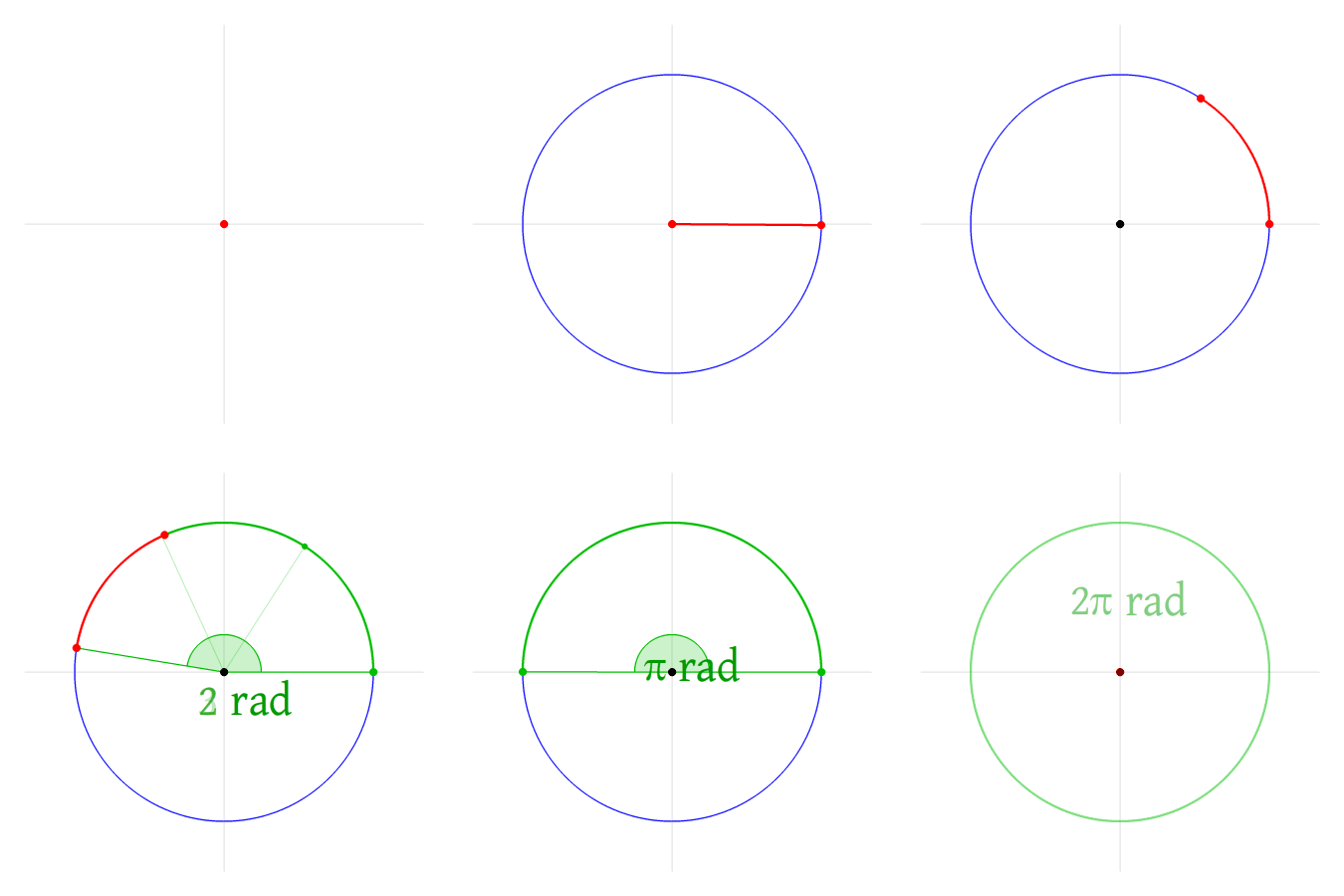
The radian and its relation to the circle

Unequal-sized columns

If my picture is too tall, I normally just increase the width of the other column rather than adjust the size of the image directly. This column is 60% wide.

Fermat’s last theorem:

\[ x^n + y^n = z^n \]

for \(x,y,z \in \mathbf{N}\) is not possible for \(n > 2\).

A male northern Cardina

Code and outputs

Code

It is quite easy to show code and their results. E.g. here is some Python code:

[x**2 for x in range(5)]
[0, 1, 4, 9, 16]

Also you can hide the code and just show the generated output/figure.